Appliances

9 Best Air Quality Monitors of 2026: Trustworthy Data for Home Reno

Which air quality monitors actually deliver reliable data on paint fumes, dust, and CO2 — so you can breathe easier through every home decorating project.

Many air quality monitors promise professional-grade accuracy, but once you start painting or unboxing new furniture, you may find the formaldehyde sensor barely budges or the WiFi drops every time you walk out of the room. That disconnect between marketing and real life leaves home decorators unsure which numbers to trust.

This guide zeroes in on what actually matters: which sensor types hold up, which connectivity headaches you can avoid, and which monitors will give you a reliable picture of the air while you redecorate. Instead of chasing every spec, we focus on the pollutants your projects are most likely to spike.

Treat chemical sensors as trend indicators rather than lab instruments, and know that a dependable CO2 or dust reading may be worth more than a dozen shaky VOC numbers. Armed with that mindset, you can choose a monitor that fits your space and your renovation timeline without overpaying for features you won't use.

#1

Best Overall

BREATHE Airmonitor Plus

BREATHE Airmonitor Plus

4.2
  • Power Source: AC powered (USB)
  • Sensor Types: CO2, PM1/2.5/10, TVOC, HCHO
  • Display Quality: Compact on-device screen
  • Smart Integration: Breathe Tech app
Check Price

Pros

  • Setup takes minutes: plug in, download the app, and the monitor instantly begins streaming pollutant data.
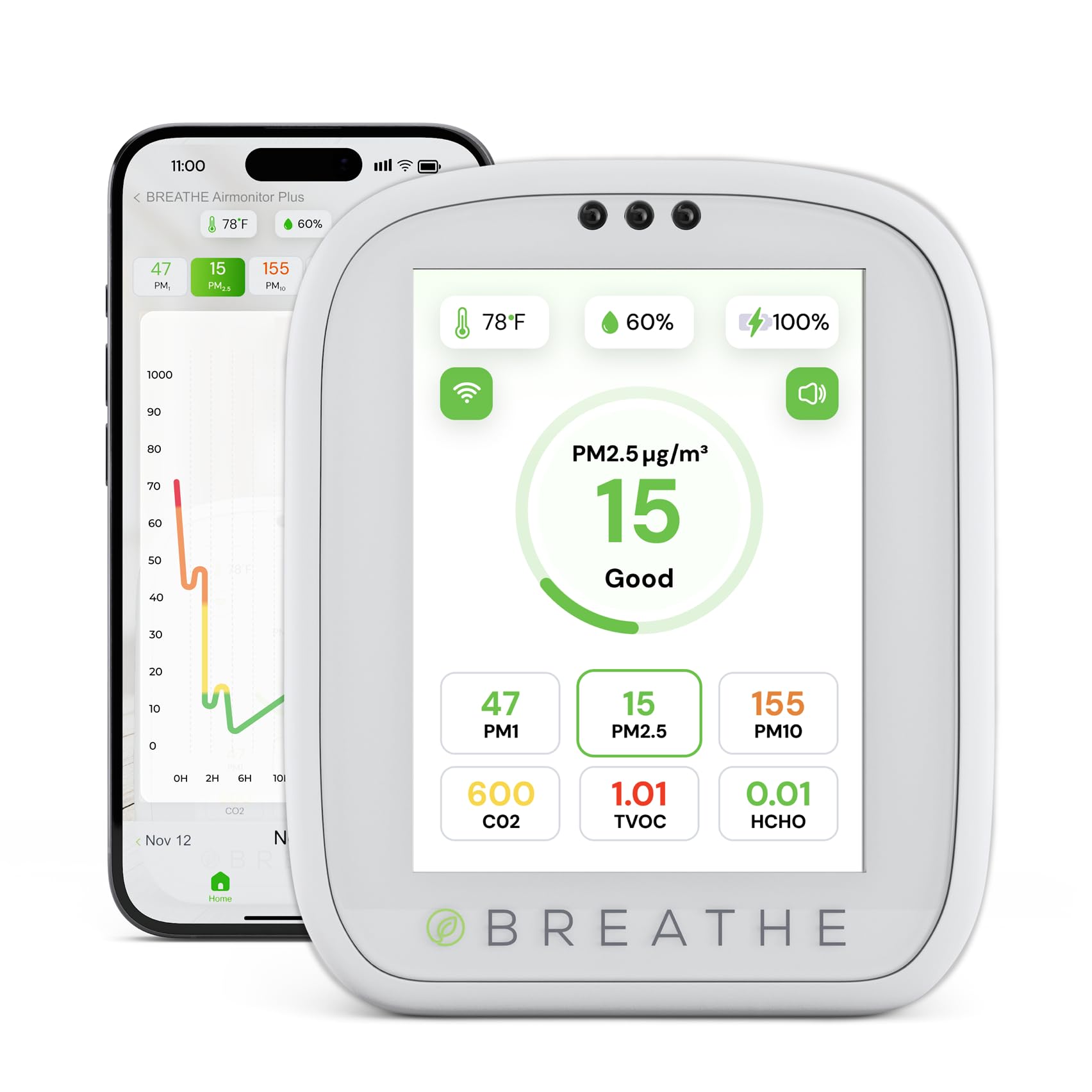
  • Full-array sensor records CO2, PM1/2.5/10, TVOC, and formaldehyde under one roof, eliminating the need for multiple gadgets.
  • Compact mid-century design with a bright LED display that’s readable from across a living room or kitchen.
  • App delivers 30 days of granular history and customizable alert thresholds so you can act on trends, not just spot readings.

Cons

  • WiFi drops can interrupt the app connection, requiring occasional re-pairing or router repositioning to restore sync.
  • Battery drains to empty in a few hours of unplugged use; for continuous monitoring the device must stay tethered to USB power.

Inside the Airmonitor Plus is a dense sensor suite: a laser particle counter for PM1, PM2.5, and PM10, an NDIR CO2 sensor, an electrochemical formaldehyde cell, and a TVOC chip. That multi-analyte coverage means a single glance tells you whether stale air, cooking smoke, or new-carpet fumes are driving the reading, rather than guessing from a generic AQI number.

The Breathe Tech app captures every data point and turns it into a 30-day scrolling timeline of temperature, humidity, and each pollutant. You can set custom alert thresholds for, say, CO2 above 1000 ppm or PM2.5 over 35 µg/m³, and the history makes it easy to connect ventilation changes — like cracking a window at night — to real improvements in air quality.

Because the battery runs down in a few hours, the Airmonitor Plus lives on its USB cable, which aligns with its role as a stationary room monitor rather than a grab-and-go gadget. WiFi can occasionally drop the app connection; moving the unit closer to the router or re-pairing usually restores syncing without data loss.

This is the right sensor for a homeowner who’s just refinished floors, repainted a nursery, or assembled a roomful of pressboard furniture and wants to track off-gassing over days and weeks. It expects to stay plugged in and to be checked via the phone app, so it won’t suit grab-and-go spot tests or anyone who wants a fully standalone display with no phone involved. If you need formaldehyde and CO2 in a single device with trend data, it’s the only option in this group that delivers both.

💡 Tip: Choose a permanent spot near new furniture or a freshly painted room, leave the monitor plugged into USB power, and check the app weekly to see how off-gassing declines over a full 30-day window.

Bottom Line: When you need one device that logs CO2, particulates, VOCs, and formaldehyde over time, the Airmonitor Plus is the one that does it — just treat it like a corded appliance, not a portable widget.
#2

Best for Alexa Integration

Amazon Smart AQ Monitor

Amazon Smart AQ Monitor

4.2
  • Power Source: Plug-in AC
  • Sensor Types: PM2.5, VOC, CO
  • Display Quality: Color-coded LED, app dashboard
  • Smart Integration: Alexa routines, voice
Check Price

Pros

  • Guided setup in the Alexa app gets the monitor online with clear, step-by-step instructions.
  • Alexa routines can automatically trigger air purifiers, fans, or lights when PM or VOC levels spike.
  • Integrated CO sensor adds basic carbon monoxide detection alongside temperature and humidity.
  • Color-coded LED glows green, yellow, or red for quick at-a-glance status.

Cons

  • Temperature readings can drift by several degrees with no manual calibration available.
  • Some units may drop WiFi connectivity or become unresponsive, requiring a power cycle to restore function.

Seamless Alexa routines allow this monitor to turn on a compatible air purifier or fan the moment particulate or VOC levels rise. Guided app setup gets the device online quickly, and once connected, you can ask Alexa for a room’s air quality score, humidity, or temperature. A carbon monoxide sensor adds a safety layer, alerting you through the app and via voice announcements.

Air quality data is better used for spotting trends than for obtaining clinically precise readings. VOC sensor inconsistencies can make cross-unit comparisons unreliable, and there is no manual calibration to nail down exact values. For households where automation is more important than absolute numbers, the monitor still provides useful alerts that can trigger Alexa routines.

This monitor fits Alexa smart home users who want air quality-informed automation. It does not measure CO2 or formaldehyde, so it is not the right choice for monitoring off-gassing from new furniture or ensuring proper ventilation around gas appliances; the top pick covers those chemicals. If your primary use case is automatically clearing out cooking smoke, wildfire haze, or high pollen days, the Amazon monitor’s voice-driven routines deliver hands-free air management.

💡 Tip: Place the monitor away from direct sunlight and HVAC vents to minimize temperature discrepancies, since manual calibration is not supported.

Bottom Line: If your priority is having Alexa announce air quality changes and trigger purifiers automatically, this monitor integrates without complexity. For tracking CO2 or formaldehyde, the top pick covers those chemicals.
#3

Best Budget WiFi PM2.5 Monitor

GoveeLife PM2.5 Monitor

GoveeLife PM2.5 Monitor

4.4
  • Power Source: USB-C powered
  • Sensor Types: PM2.5, temperature, humidity
  • Display Quality: LED indicator, light bar
  • Smart Integration: Govee Home app, Wi-Fi
Check Price

Pros

  • Effortless WiFi setup in minutes
  • Consistent PM2.5 readings with 2-second refresh and a color-coded air quality light.
  • Govee app and Home Assistant integration for automating purifiers and heaters based on PM2.5 levels.
  • Two-year data storage and CSV export for long-term dust trend analysis.

Cons

  • No battery
  • Doesn't measure CO2, VOCs, or formaldehyde

Where multi-gas monitors attempt broad coverage, the GoveeLife PM2.5 Monitor concentrates on particulate matter and climate, pulling data into the Govee Home app every two seconds. That fast refresh, combined with a color-coded LED ring, makes it a practical desk companion during cooking, cleaning, or seasonal dust spikes. The companion app stores two years of history and exports to CSV, so you can correlate dust levels with activities or weather.

Setup takes only a few minutes — the device walks itself onto your WiFi network, and the screen displays current PM2.5 alongside a clock and air quality color. The LED brightness is adequate for daytime visibility, and the 2-second refresh keeps readings current during sudden dust events. While the screen does not cycle through all metrics, the app provides numeric readouts for temperature and humidity alongside PM2.5 history.

This monitor is best for Govee ecosystem users who want to automate purifiers or heaters based on PM2.5 thresholds, and for anyone prioritizing dust tracking over chemical gas detection. Keep in mind that the temperature sensor can sometimes read a couple of degrees warmer or cooler than a standalone thermostat — it's useful for spotting trends but not for precision climate calibration.

Bottom Line: If your air quality concerns center on dust and you're already in the Govee ecosystem, this monitor's low cost and automation capabilities make it a smart hub for purifier control. Look elsewhere if you need CO2 or VOC monitoring.
#4

Best for Accurate CO2 Monitoring

GoveeLife CO2 Monitor

GoveeLife CO2 Monitor

4.5
  • Power Source: AC powered
  • Sensor Types: CO2, temperature, humidity
  • Display Quality: LED with tri-color bar
  • Smart Integration: Govee app, alerts
Check Price

Pros

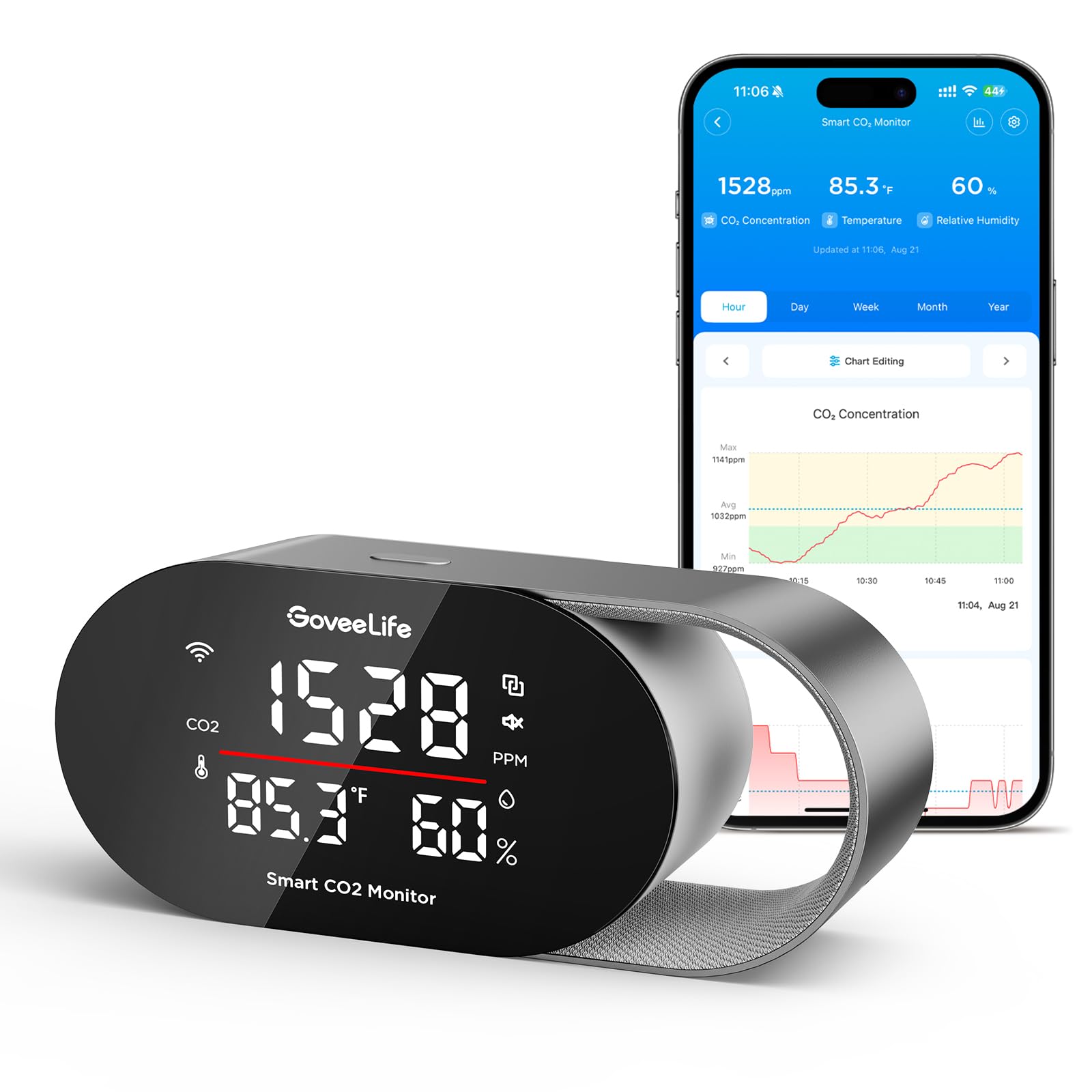
  • High-accuracy NDIR CO2 sensor delivers fast, actionable readings that help improve sleep quality and focus.
  • Triple-alert system — buzzer, phone notification, and email
  • Two-year data history with CSV export for long-term trend analysis.
  • Glanceable LED display with customizable brightness and a tri-color light bar for quick status checks.

Cons

  • WiFi connection can drop unexpectedly, interrupting remote alerts and remote data access.

Unlike Govee's dust-focused monitors, this unit homes in on CO2 with a high-accuracy NDIR sensor that refreshes every five seconds — the pollutant most directly tied to drowsiness and poor concentration in sealed spaces.

It's built for bedrooms, nurseries, and offices where stale air can compromise sleep or productivity. Data-minded users will appreciate the two-year history with CSV export for spotting patterns. Govee ecosystem owners can link it to humidifiers and fans to automate air quality management.

The alert system covers three channels — buzzer, app push, and email — with customizable thresholds so you won't miss a spike. The LED display uses a tri-color light bar and adjustable brightness for at-a-glance awareness without distraction. WiFi connectivity can be intermittent; if the device drops offline, remote alerts may not push until it reconnects. Since it plugs in, this is a stationary device — plan on leaving it in one spot.

💡 Tip: Position the monitor within reliable WiFi range and consider a power cycle routine if disconnections occur; for critical CO2 alerts, rely on the onboard buzzer as a backup.

Bottom Line: For anyone who needs a CO2-specific monitor with rich data logging and smart automation, this GoveeLife unit delivers the sensor quality and alert coverage that matter — just accept the WiFi hiccups and leave it in one place.
#5

Best Large Display for Easy Reading

YNAK 16-in-1 Monitor

YNAK 16-in-1 Monitor

4.3
  • Power Source: Rechargeable battery, 8h
  • Sensor Types: CO2, PM, HCHO, TVOC
  • Display Quality: 7-inch LED screen
  • Smart Integration: Standalone, no app
Check Price

Pros

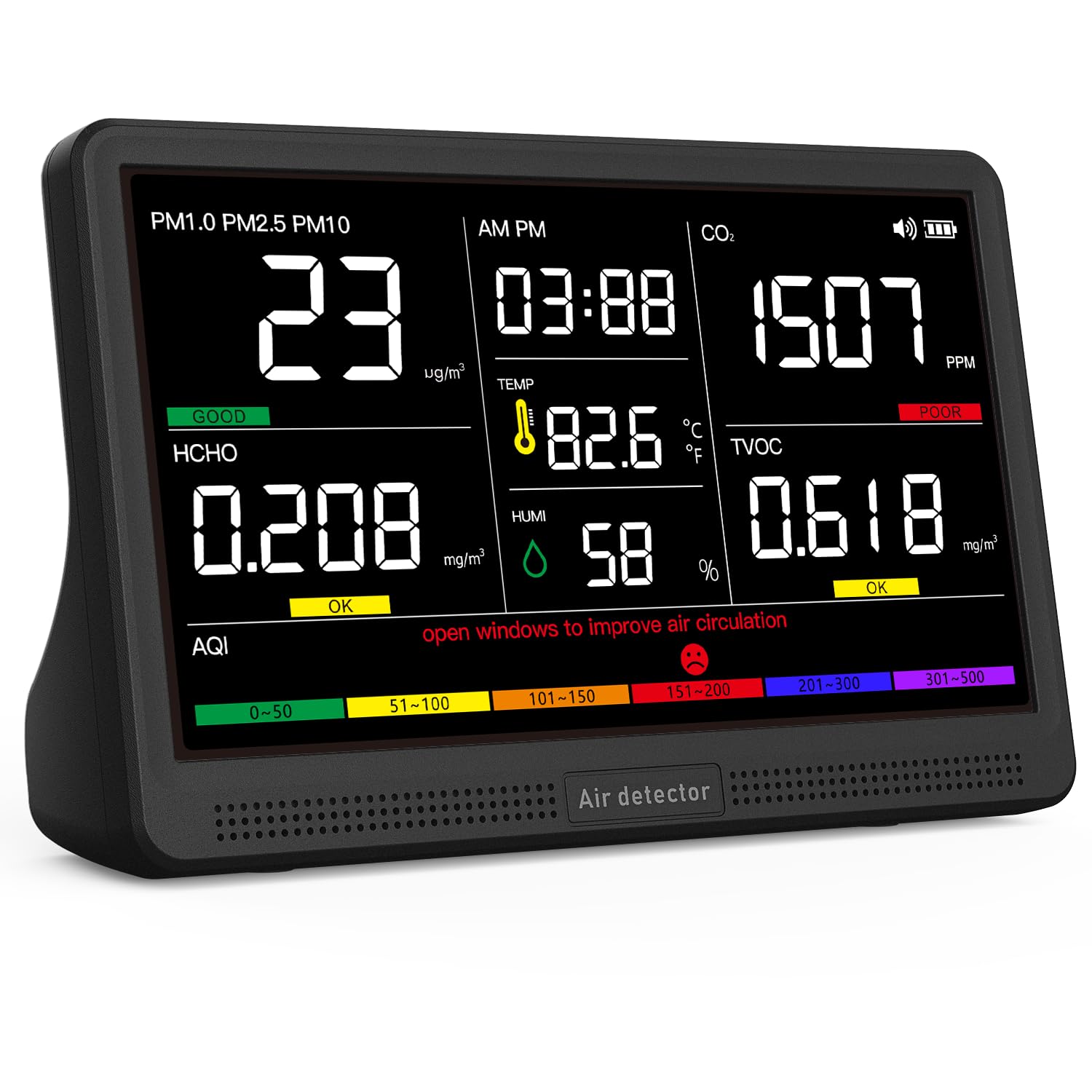
  • Large, bright 7-inch display makes all metrics readable from across the room
  • Picks up air quality changes quickly, giving a clear overview of CO2, PM, and climate shifts
  • Simple setup and intuitive button controls for brightness and time
  • Seven distinct AQI alert buzzers with a mute button for quiet periods

Cons

  • Hardware longevity can vary

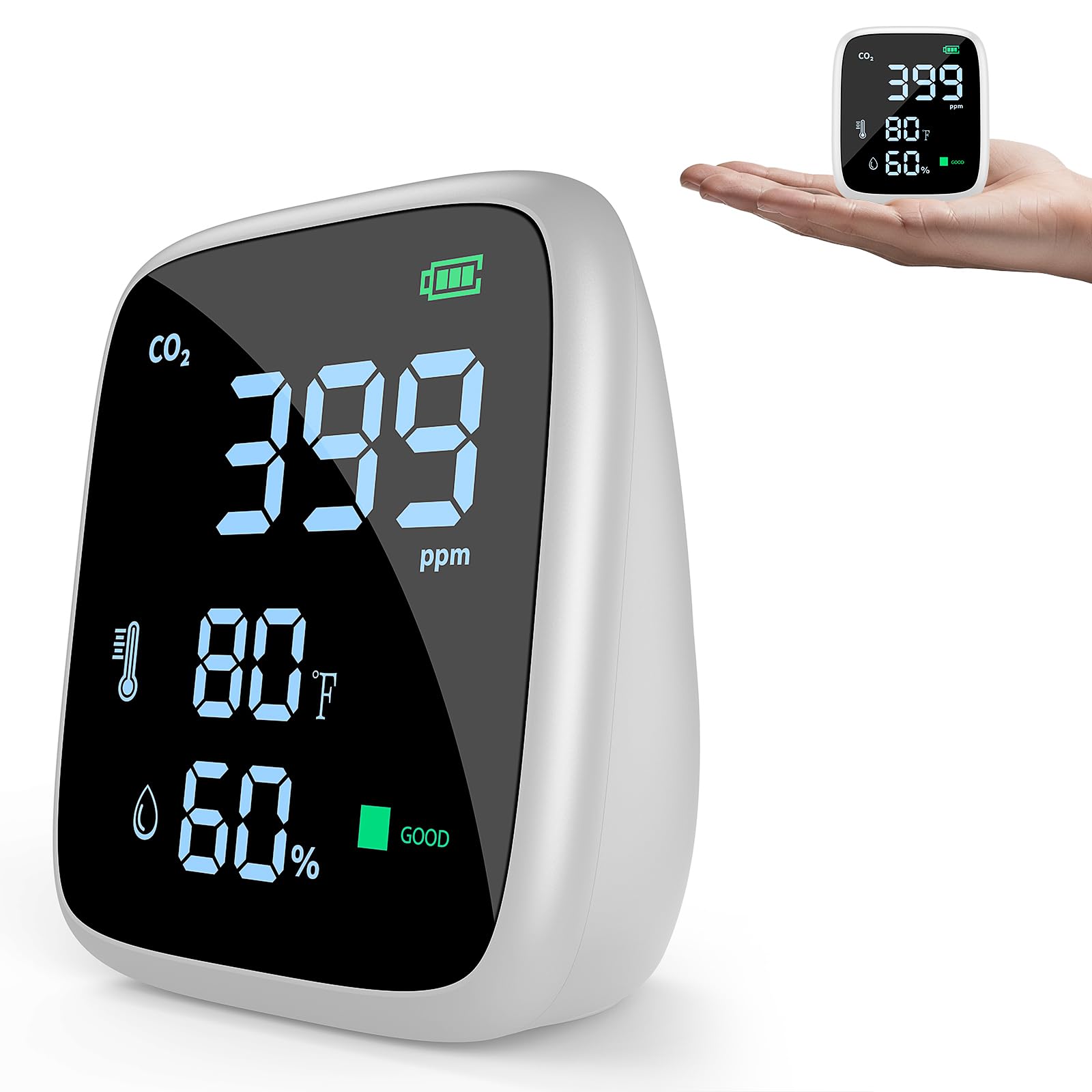
With its 7-inch LED screen, the YNAK monitor puts CO2, PM2.5, temperature, humidity, and AQI on one bright, glanceable panel — color-coded bands let you assess air health instantly from across the room. Unlike the top pick, which leans on a smartphone app for a full multi-parameter view, this device keeps every number visible without unlocking a phone, making it the most glanceable option in the roundup.

The interface is refreshingly direct: three brightness levels, a large time display, and tactile buttons. It takes just a few minutes to set up, and the sensor responds quickly to real changes — a CO2 rise during a family dinner or PM2.5 from a smoky kitchen appears promptly, giving you an at-a-glance trend without opening an app.

Best suited for living areas and kitchens where multiple people can look at the same display, especially with older adults or tech-averse users who appreciate the large, colorful numbers and alert beeps. A mute button quiets alarms when needed, and the 8-hour cordless battery lets you move it between rooms for spot checks. Still, approach TVOC and formaldehyde numbers as rough indicators — they can be significantly underestimated. And note: some units have stopped working after a couple of months, so plan for possible early replacement.

💡 Tip: Register the device immediately and keep the packaging — the large display is great, but having a backup plan for warranty support within the first few months is wise.

Bottom Line: A big-screen air quality dashboard that puts CO2, PM, and climate readings front and center — ideal if you'd rather glance at a wall than open an app. Just set expectations around chemical sensor accuracy and be prepared for the possibility of an early replacement.
#6

Best Portable Multi-Sensor Standalone

LifeBasis 11-in-1

LifeBasis 11-in-1

4.3
  • Power Source: Rechargeable battery, 12h
  • Sensor Types: PM, CO2, TVOC, HCHO
  • Display Quality: LCD color-coded icons
  • Smart Integration: Standalone, no app
Check Price

Pros

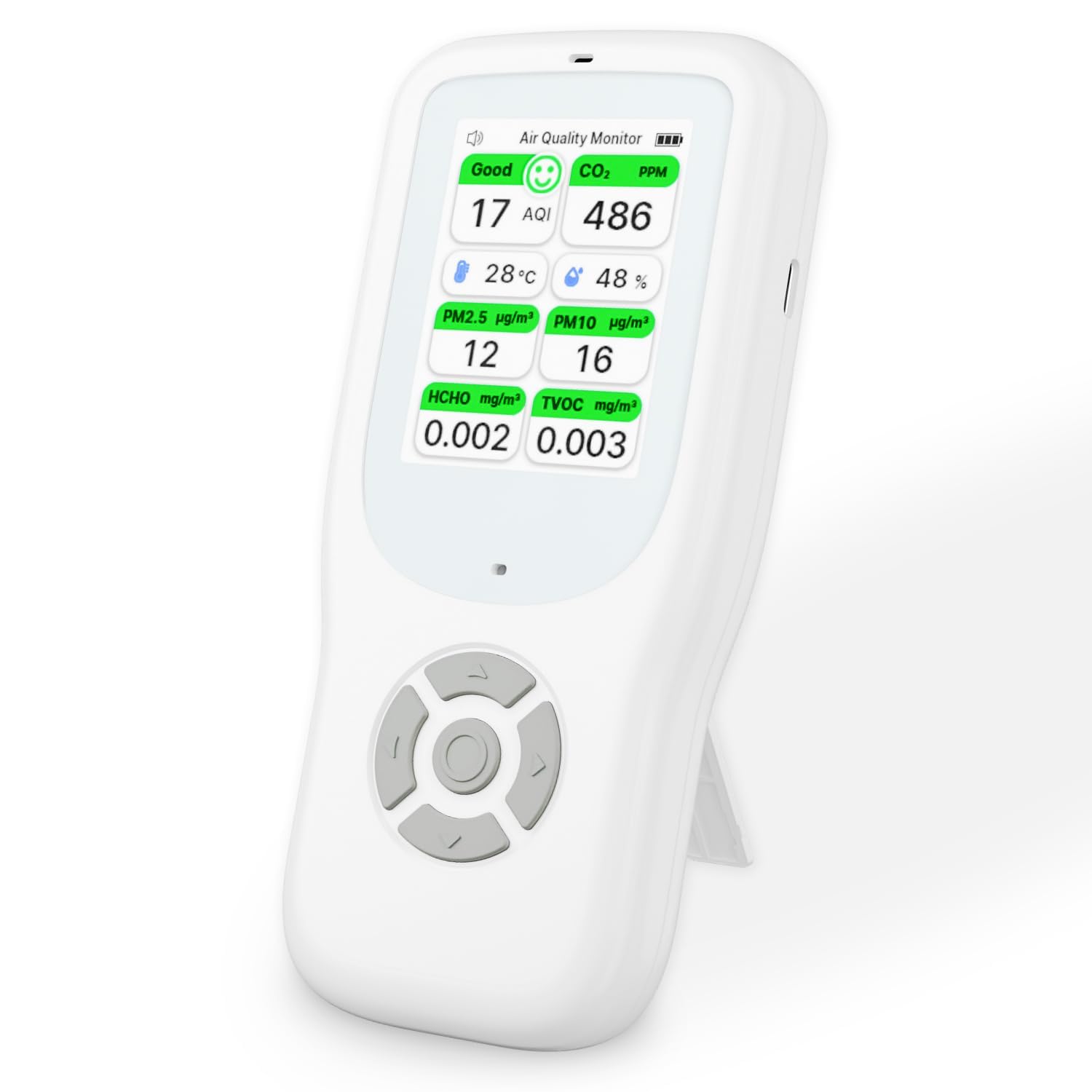
  • 11-in-1 display with color-coded icons and audible alarms makes scanning all parameters glanceable.
  • CO2 and PM readings react within seconds to ventilation changes or air purifier use, providing near-real-time feedback.
  • 2500mAh battery supports all-day room-to-room testing on a single charge, then recharges via USB-C.
  • Calibration completes in minutes with a few button presses; the manual is clear and straightforward.

Cons

  • No companion app or smart home connectivity
  • TVOC and formaldehyde readings can be inconsistent or implausible; not suitable for tracking chemical off-gassing.

A built-in 2500mAh battery and 11 onboard sensors give the LifeBasis a distinct edge for quick, app-free room checks—no need to plug in or unlock a phone. Unlike stationary monitors with large displays, it travels from the nursery to the garage on a charge. CO2 and particulate readings shift within seconds of opening a window or turning on an air purifier, while the bright LCD uses color-coded icons and a beep to flag worsening levels.

The USB-C rechargeable battery lasts around 11 hours of intermittent spot-checking, so you can test a kitchen after cooking and then a bedroom with new curtains on a single charge. Calibration is simple: a few button presses in fresh air, and the CO2 baseline sets quickly. A built-in stand props it upright on a nightstand or shelf.

This monitor suits decorators, DIYers, and households that want a grab-and-go sensor for CO2 and particle counts after applying paint, adhesives, or installing new flooring. The TVOC and formaldehyde sensor can be unresponsive or show implausible values, so it is not a tool for verifying low-VOC claims or tracking off-gassing over time — the top pick’s app-based trend monitoring fills that role. If you mainly care about CO2 buildup, dust, and smoke, the 11-in-1 delivers without needing a smartphone.

Bottom Line: If you need a cordless monitor to check CO2 and particle counts after new furniture or renovations, this handheld unit is a practical choice — just treat the VOC reading as a placeholder.
#7

Travel CO2 checks

Dienmern CO2 Detector

Dienmern CO2 Detector

4.5
  • Power Source: Rechargeable 72h
  • Sensor Types: CO2, temperature, humidity
  • Display Quality: LED screen
  • Smart Integration: None
Check Price

Pros

  • Up to 72 hours of cordless use from a single charge, ideal for portable spot checks
  • Swiss-made sensor delivers CO2 readings within ±50ppm, sufficient for everyday awareness
  • Simple LED interface shows CO2, temperature, and humidity without needing an app

Cons

  • No Wi-Fi or app connectivity
  • Limited to CO2, temperature, and humidity

This pocket-sized detector runs for up to 72 hours on a single charge, thanks to its 1600mAh battery, and uses a Swiss NDIR sensor for CO2 accuracy within ±50ppm. The LED screen displays CO2, temperature, and humidity at a glance, making it a practical choice for growers, travelers, or office workers who only need to check ventilation levels. But it stops there — there is no detection for particulates, VOCs, or formaldehyde, and no Wi-Fi or app connectivity to log data or send alerts. For anyone whose search started with multi-pollutant monitoring, this purely CO2-focused device is a deliberate simplification, not a weakness.

Bottom Line: Buy this if you want a long-lasting, grab-and-go CO2 checker for a single room, travel, or grow tent and don’t need particulate or VOC readings.
#8

Basic spot checks

Bcetasy 11-in-1

Bcetasy 11-in-1

4.2
  • Power Source: Rechargeable battery, 12h
  • Sensor Types: CO2, PM, TVOC, HCHO
  • Display Quality: LCD color-coded icons
  • Smart Integration: Standalone
Check Price

Pros

  • Sensitive to immediate changes like a candle or open window, giving real-time visual feedback.
  • Rechargeable 2500mAh battery delivers up to 12 hours of use, with USB-C convenience.
  • Color-coded LCD and audible alarm system let you gauge air quality at a glance without studying numbers.

Cons

  • No companion app or smart home connectivity; all monitoring stays on the device screen.
  • Long-term sensor drift and durability haven't been verified; best treated as a secondary spot checker.

The Bcetasy 11-in-1 array includes CO2, PM1.0/2.5/10, TVOC, formaldehyde, temperature, and humidity, all behind a color-coded LCD that flashes and beeps when levels rise. A 2500mAh battery keeps it running for up to 12 hours of intermittent checks, and USB-C charging means you aren't hunting for proprietary cables. It's sensitive enough to pick up the difference between a sealed room and one with an open window, making it practical for quick before-and-after tests.

Bottom Line: A grab-and-go scout for quick pollutant spikes — reserve it for spot checks rather than continuous health monitoring, and you'll get useful snapshots without overpaying.
#9

Occasional dust checks

Temtop PM2.5 Monitor

Temtop PM2.5 Monitor

4.1
  • Power Source: 60-day battery
  • Sensor Types: PM2.5, AQI, temperature, humidity
  • Display Quality: LCD, no backlight
  • Smart Integration: None
Check Price

Pros

  • 60-day battery life lets you roam room to room without a cord.
  • Responds visibly to PM2.5 changes from air purifiers or activities.
  • Compact and lightweight, easy to place on a desk or shelf.

Cons

  • Temperature and humidity readings may not match dedicated sensors; use them as rough estimates.
  • Some units may develop battery issues that shorten their usable life, making them unreliable for continuous checks.

The Temtop S1's standout feature is its 60-day battery life on a single charge, letting you move it room to room for quick dust checks without hunting for a power outlet. It picks up changes in PM2.5 when an air purifier kicks on, giving a basic sense of air quality shifts. Temperature and humidity readings can disagree with other sensors, and some units may lose the ability to hold a charge within a few months. The LCD screen lacks a backlight, so you'll need decent lighting to read the numbers. For casual spot-checking in bright spaces where you accept that readings are approximate, this monitor fits. It's not suited for anyone needing continuous, accurate monitoring or health-related use.

Bottom Line: If you need a basic, cordless PM2.5 sniffer for occasional checks in well-lit rooms — and you accept that readings are approximate and the unit may not last years — this monitor does the job at an entry-level price.

How to Choose

Sensor Types and Accuracy

CO2 sensors that use NDIR technology give you dependable, repeatable numbers, while chemical sensors for VOCs and formaldehyde are more like smoke alarms — they tell you something changed, but not the exact intensity. For a freshly painted room, you want at least a formaldehyde sensor and a PM2.5 sensor to track the fine dust from sanding.

Treat VOC and formaldehyde readings as relative trend indicators. If the number jumps after you unwrap a new sofa, increase ventilation; if it stays low days later, the off-gassing has mostly passed. Don't treat a single spike as a health emergency or a zero reading as a guarantee of clean air.

Smart Home Integration and Connectivity

WiFi monitors can send alerts to your phone and trigger routines, like turning on a connected air purifier when PM2.5 rises. But nearly all of them require a stable 2.4 GHz network — many routers that blend bands or default to 5 GHz will cause frequent dropouts. Create a dedicated 2.4 GHz SSID before buying if you plan on smart features.

Standalone units with no app remove this headache entirely. They show readings on the device itself, which can be more reliable for quick checks when you're moving from room to room. Choose smart connectivity only if you'll actually use the automation and remote monitoring daily.

Display and Readability

A large, color-coded display lets you see the room's air status from across the kitchen without squinting, but it usually means the monitor must stay plugged in and isn't portable. Compact LED indicators are more subtle and energy-efficient, but you'll need to walk up close to read exact values.

If you want an at-a-glance dashboard the whole family can use, a 7-inch screen or a bright tri-color light bar is worth the trade-off in mobility. For discreet monitoring in a bedroom, a small LED ring or a simple app notification may be all you need.

Power and Portability

Monitors billed as 'portable' often drain their battery within hours when all sensors are running continuously. A listed 12-hour runtime may apply only with the screen dimmed and fewer pollutants being sampled. For full-time monitoring, a wall-powered unit is more dependable.

Rechargeable monitors shine when you want to carry a single device from room to room for spot checks after painting or assembling furniture. Look for models that explicitly state 8+ hours of cordless use with all sensors active, and plan to recharge overnight.

Data Logging and Alerts

A monitor that stores days or weeks of history reveals patterns — like whether VOC levels climb every evening when you cook or after the heat kicks on. Without logging, you only see a snapshot, which can make you overreact to temporary spikes.

Customizable alerts let you set personal thresholds for CO2 or dust, delivering a ping to your phone or an audible beep before the air gets stuffy. If you're monitoring a nursery or home office, look for triple-channel warnings (buzzer, app push, and email) so you never sleep through an alert.

Frequently Asked Questions