Storage

11 Best Compost Bins of 2026: Built to Last and Turn Smoothly

Find durable compost bins that actually hold up and turn smoothly — from tumblers to indoor worm systems. Which ones make rich compost without cracking under sun and heavy loads.

Assembling a new compost tumbler shouldn’t require an engineering degree, yet confusing instructions and dozens of tiny nuts and bolts are the norm. Many bins begin to crack or warp after just one season in the sun, leaving you with a broken plastic shell and unfinished compost.

But a handful of well-designed composters break that pattern. Whether you need a dual-chamber tumbler that spins easily, a simple stationary bin that sets up in minutes, or an odor-free indoor worm system, the right bin stays sturdy and produces rich compost without constant fussing.

For home decorating enthusiasts, a compost bin is a garden accent, not just a utility bin. The models we recommend come in clean, dark finishes with smooth lines that look intentional in a landscaped yard — complementing your beds rather than cluttering them. From compact tumblers that tuck beside a raised bed to sleek indoor worm bins that fit a pantry, there’s a design that works without sacrificing style.

#1

Best Overall

FCMP IM4000 37-Gal Tumbler

FCMP IM4000 37-Gal Tumbler

4.5
  • Type: Dual-chamber tumbling composter
  • Capacity: 37 gal
  • Pest Resistance: Enclosed, critter-resistant
  • Ease of Assembly: Requires patience, power drill helpful
Check Price

Pros

  • Easy to turn and spin, even for beginners filling the chambers — 1,343 mentions, 74% positive
  • Robust build quality with dense materials that hold up well — 1,116 mentions, 93% positive
  • Produces consistent compost in real backyard conditions — 855 mentions, 92% positive
  • Sturdy once assembled, withstanding frequent turning and weather — 839 mentions, 87% positive

Cons

  • Plastic axle area and frame screws may struggle under heavy loads; spindle can tear through the body — 536 mentions, 52% negative — vulnerability to axle damage and screw breakage exists
  • Assembly is tedious: dozens of small nuts and bolts with confusing instructions, requiring a drill and helper — 2,303 mentions, 49% negative; 616 mentions on instructions, 74% negative

The FCMP IM4000’s recycled polypropylene body is noticeably heavier and denser than the flimsy plastic on many budget tumblers, and that extra heft translates into a smooth, low-effort spin. Dual chambers let you keep adding scraps to one side while the other matures, so the stream of finished compost never has to stop. Even with a nearly full drum, turning requires very little muscle.

Over multiple seasons, the galvanized steel frame shrugs off rain and sun, and the plastic body resists becoming brittle. The tumbling motion actually improves as the seams settle, and the enclosed design keeps out raccoons and rodents. For a medium-sized garden, the 37-gallon capacity delivers a steady volume of compost without the manual labor of turning an open pile.

This tumbler suits a homeowner who wants a consistent compost supply and is comfortable with a detailed assembly project. The enclosed drum is a genuine advantage if you have curious critters. The tradeoff is upfront: putting it together asks for patience. You will face dozens of tiny nuts and bolts and an instruction sheet that can confuse even handy people. A power drill and a helper turn the job from a frustration into a manageable hour-long task.

💡 💡 Tip: Set aside an hour with a power drill and a second pair of hands — pre-sorting the hardware before you start cuts down frustration.

Bottom Line: For medium-garden composters who value long-term durability and don’t mind a one-time assembly project, the IM4000 delivers years of mostly trouble-free tumbling and a steady compost supply.
#2

Best Value Dual-Chamber Tumbler

VIVOSUN 43-Gal Tumbler

VIVOSUN 43-Gal Tumbler

4.3
  • Type: Tumbling composter, 360° rotation
  • Capacity: 43 gal
  • Pest Resistance: Enclosed tumbler
  • Ease of Assembly: Time-consuming, unclear instructions
Check Price

Pros

  • Sturdy galvanized steel frame and solid plastic body that hold up under regular tumbling — 352 mentions, 80% positive
  • Effectively transforms kitchen scraps and yard waste into finished compost — 218 mentions, 88% positive
  • Dual chambers enable continuous composting — one side cures while the other is filled

Cons

  • Narrow door openings can make adding bulky garden cuttings or emptying the bin more awkward than on models with larger access panels — 207 mentions, 56% negative
  • Assembly is a tedious process with poorly translated instructions, dozens of unlabeled screws, and small hardware that demands patience — 883 mentions, 51% negative; 190 mentions on instructions, 77% negative

With its 43-gallon dual-chamber design and galvanized steel frame, the VIVOSUN tumbler follows the same tumbling formula as the top pick at a noticeably lower price point. The body feels sturdy and effectively breaks down kitchen scraps and yard waste into usable compost. Two separate chambers allow one side to cure while the other is actively filled, keeping the process continuous. The assembly process, however, is a patience test — a booklet of poorly translated instructions and dozens of unlabeled screws can turn setup into a half-hour ordeal. Once assembled, the doors open just enough for thin kitchen scraps but can feel restrictive when adding whole garden prunings or emptying the finished batch.

This tumbler suits gardeners with moderate food-scrap volumes who want continuous composting and are willing to tolerate the extra assembly steps. If you dread fussy hardware or need wide-open access for bulky yard debris, the snap-together stationary bins or the top pick’s slightly larger doors may be a better fit.

💡 💡 Tip: Use a drill with a hex bit and pre-sort the screws — the unlabeled parts become far less intimidating.

Bottom Line: If you’re already eyeing the top pick’s assembly challenge, this VIVOSUN gives you the same tumbling action with a smaller budget — just accept the same patience test and tighter door access.
#3

Best No-Fuss Stationary Bin for Beginners

Redmon 65-Gal Bin

Redmon 65-Gal Bin

4.5
  • Type: Stationary compost bin
  • Capacity: 65 gal
  • Pest Resistance: Open bottom, not pest-proof
  • Ease of Assembly: Snap-together, under 10 min, no tools
Check Price

Pros

  • Tool-free assembly takes under 10 minutes from unboxing to filling — 357 mentions, 97% positive
  • Sturdy assembled structure stands firm without tipping — 191 mentions, 96% positive
  • Four doors and a lift-off lid make adding scraps and harvesting compost accessible from all sides — 140 mentions, 94% positive

Cons

  • Pre-installed plastic bolts can arrive stripped or missing, occasionally requiring a hardware store run to finish assembly — 82 mentions, 83% negative

The Redmon 65-gallon bin assembles without tools — panels click into place in under 10 minutes, forming a stable cylinder ready to fill. Unlike giant open-frame yard-waste bins that demand rebar and careful staking, the Redmon’s four-side door design and lift-off lid stay upright on their own, making it the most accessible stationary composter for a beginner’s kitchen scraps and moderate yard waste.

This bin is for the first-time composter who wants to start today, not after an afternoon of assembly. The open bottom requires direct soil contact, so it suits a garden bed or dirt patch, not a deck or paved area. On the hardware side, the pre-installed plastic bolts occasionally arrive stripped or missing — a frustration that can stall assembly but is usually resolved with a quick replacement. The overall system remains so straightforward that the tradeoff is minor.

Bottom Line: If you’re new to composting and want a bin you can set up and fill before lunch, the Redmon is the most approachable option — just open the box and start.
#4

Best Apartment Worm Composter

VermiHut 5-Tray Worm Bin

VermiHut 5-Tray Worm Bin

4.5
  • Type: Stackable worm composter
  • Capacity: 13.2 gal (50L)
  • Pest Resistance: Sealed, odor-free indoors
  • Ease of Assembly: Easy assembly, simple
Check Price

Pros

  • Worms multiply and break down scraps quickly, supporting healthy, sustained composting. — 112 mentions, 70% positive
  • Assembly and castings harvesting require minimal effort, thanks to the tray design. — 80 mentions, 98% positive
  • Lid seals in odors completely, keeping the unit unobtrusive indoors. — 60 mentions, 98% positive

Cons

  • Tray material can feel thin; stacking requires precise alignment to prevent stray worms from escaping. — 55 mentions, 33% negative — occasional escape incidents reported, but most users resolve with proper setup

Unlike electric kitchen composters that dehydrate scraps, the VermiHut 5-tray system uses live worms to produce finished castings — a true soil amendment. The stackable design keeps the process contained and odor-free when the lid is shut, making it viable for kitchens or utility rooms. Harvesting is simplified: add food to the top tray, and as worms migrate upward through the trays, finished castings collect in the lower levels for easy removal.

Apartment dwellers and small-space gardeners gain access to rich worm compost without outdoor tumblers. The trays can flex slightly, so careful alignment is needed to prevent occasional worm wanderings; once dialed in, the bin stays tidy. This is not for handling yard waste or large volumes — it thrives on daily kitchen scraps.

💡 💡 Tip: Press each tray down firmly after adding scraps; check alignment weekly to keep worms safely inside.

Bottom Line: A compact, odor-free worm bin that fits apartment living and rewards careful setup with steady castings. Consider other options if you're squeamish about worms or need to process yard waste.
#5

Best Ultra-Budget Tumbler

F2C 43-Gal Tumbler

F2C 43-Gal Tumbler

4.4
  • Type: Dual-chamber tumbling composter
  • Capacity: 43 gal
  • Pest Resistance: Enclosed tumbler
  • Ease of Assembly: Tedious, many bolts and nuts
Check Price

Pros

  • Budget-friendly cost gets you a fully functional dual-chamber composter. — 75 mentions, 93% positive
  • Sturdy steel frame prevents tipping even when cranking a loaded drum. — 130 mentions, 82% positive
  • Clean yard appearance and consistent breakdown of kitchen scraps. — 149 mentions, 88% positive

Cons

  • Assembly involves dozens of small nuts and bolts with vague instructions; panel alignment can be tricky. — 291 mentions, 44% negative
  • Sliding doors may be stiff to open and close, and turning grows harder as the chambers fill. — 139 mentions, 37% negative

Among dual-chamber tumblers, this model undercuts the competition with a rock-bottom price that leaves no room for extra refinement. The 43-gallon capacity and heavy steel frame give it a solid presence in the yard once assembled, but that sturdiness comes after a lengthy assembly with dozens of small nuts and bolts. You trade a smoother out-of-box experience for the lowest possible entry fee.

The heavy steel frame resists tipping even under full load, and the dark plastic chambers absorb sun heat to speed decomposition. Assembly demands patience with vague instructions and numerous small fasteners. The sliding doors may need breaking in, and turning effort increases as chambers fill. For first-time composters focused solely on budget, this tumbler handles kitchen scraps and yard clippings capably, accepting that some polish is missing.

💡 💡 Tip: Use a power drill with a nut driver bit to cut assembly time, and lubricate door tracks with silicone spray for smoother sliding.

Bottom Line: If you accept a lengthy assembly and doors that may need breaking in, this tumbler delivers basic, reliable composting at the lowest price in its category.
#6

Best Indoor Electric Composter

Ouaken 4L Electric Composter

Ouaken 4L Electric Composter

4.2
  • Type: Electric countertop composter
  • Capacity: 4 L
  • Pest Resistance: Fully sealed
  • Ease of Assembly: No assembly, plug and use
Check Price

Pros

  • Whisper-quiet operation, barely audible over conversation, so it can run overnight without disturbance. — 127 mentions, 87% positive
  • Built-in carbon filter traps odors completely, keeping kitchen air fresh even with a full bucket. — 131 mentions, 74% positive
  • One-button operation and dishwasher-safe bucket make daily use effortless. — 108 mentions, 92% positive

Cons

  • The lid can crack and the motor may stop working after months of daily use, requiring warranty support. — 74 mentions, 61% negative

The Ouaken 4L Electric Composter turns kitchen scraps into a dry, soil-like material overnight using automated grinding and heating, sidestepping the need to manage worms or wait weeks for outdoor breakdown. It runs under 40 dBA — barely louder than a conversation — and the large carbon filter keeps odors completely contained, making it suitable for open-plan kitchens.

This machine is tailored to apartment dwellers, condo owners, and small families who lack outdoor compost space. The 4-liter bucket keeps up with daily scraps for one or two people, but larger households will find the capacity limiting. Long-term durability is the main concern: the lid can develop cracks, and motor failures have been reported after months of consistent use, so an extended warranty is worth considering. For those willing to accept that risk, the odorless, one-button operation brings real composting indoors without mess or smell.

Bottom Line: The Ouaken delivers a genuinely odorless, effortless indoor composting experience that outdoor bins can't match, but expect to lean on the warranty — durability at this price should be better.
#7

Large yards

Geobin 216-Gallon Compost Bin

Geobin 216-Gallon Compost Bin

4.4
  • Type: Stationary open-bottom bin
  • Capacity: 216 gal
  • Pest Resistance: No pest protection
  • Ease of Assembly: Clip-together, no tools
Check Price

Pros

  • Clips together in minutes without tools, far simpler than building a wire bin. — 591 mentions, 90% positive
  • Remarkably cost-effective for the volume it provides — the most compost capacity per dollar among ready-made bins. — 286 mentions, 87% positive

Cons

  • Lightweight plastic sheet demands staking; collapses in wind if not anchored with rebar or heavy weights. — 216 mentions, 69% negative

Clip-together assembly and an enormous 216-gallon capacity make this bin a cost-effective way to process high volumes of leaves, grass clippings, and garden trimmings. Yard waste breaks down efficiently, particularly in dry conditions. The open-bottom design and lightweight plastic sheet demand staking with rebar or heavy weights to prevent wind collapse, and it provides no pest deterrence. This tradeoff turns it into a managed open pile rather than a sealed composter, fitting large properties where visual tidiness and critter exclusion are secondary to raw throughput.

💡 💡 Tip: Anchor with at least four rebar stakes driven through the bottom loops and into the ground to keep the bin upright in wind.

Bottom Line: For large yards generating mountains of leaves and grass clippings where an open, stake-anchored pile is acceptable, this bin offers unmatched capacity for the price.
#8

Large capacity

Miracle-Gro Large Dual Chamber Compost Tumbler Review

Miracle-Gro Large Dual Chamber Compost Tumbler Review

4.2
  • Type: Large dual-chamber tumbler
  • Capacity: 55.4 gal
  • Pest Resistance: Enclosed
  • Ease of Assembly: —
Check Price

Pros

  • Easy to turn when not overloaded; large chambers produce compost relatively quickly. — 655 mentions, 82% positive
  • Spacious enough for a small family’s kitchen waste and light yard trimmings. — 613 mentions, 78% positive

Cons

  • Plastic panels can crack or clips snap under heavy loads or from sun exposure, limiting long-term durability. — 825 mentions, 82% negative

The large dual chambers turn easily when not overloaded and hold enough waste for a small family. However, the plastic is prone to brittleness; panels can crack or clips snap under heavy loads or after months in direct sun, restricting it to light, seasonal use. It’s best suited for gardeners who value capacity over longevity and can reinforce or replace parts as needed.

Bottom Line: If you prioritize high capacity and smooth tumbling for light, seasonal composting and can tolerate potential part replacements, this tumbler offers a temporary solution.
#9

Small households

Nazhura 43-Gal Tumbler

Nazhura 43-Gal Tumbler

4.4
  • Type: Dual-chamber tumbler
  • Capacity: 43 gal
  • Pest Resistance: Enclosed
  • Ease of Assembly: Frustrating, unclear instructions
Check Price

Pros

  • Solid construction for the price, with a frame that remains stable during turning — 210 mentions, 89% positive
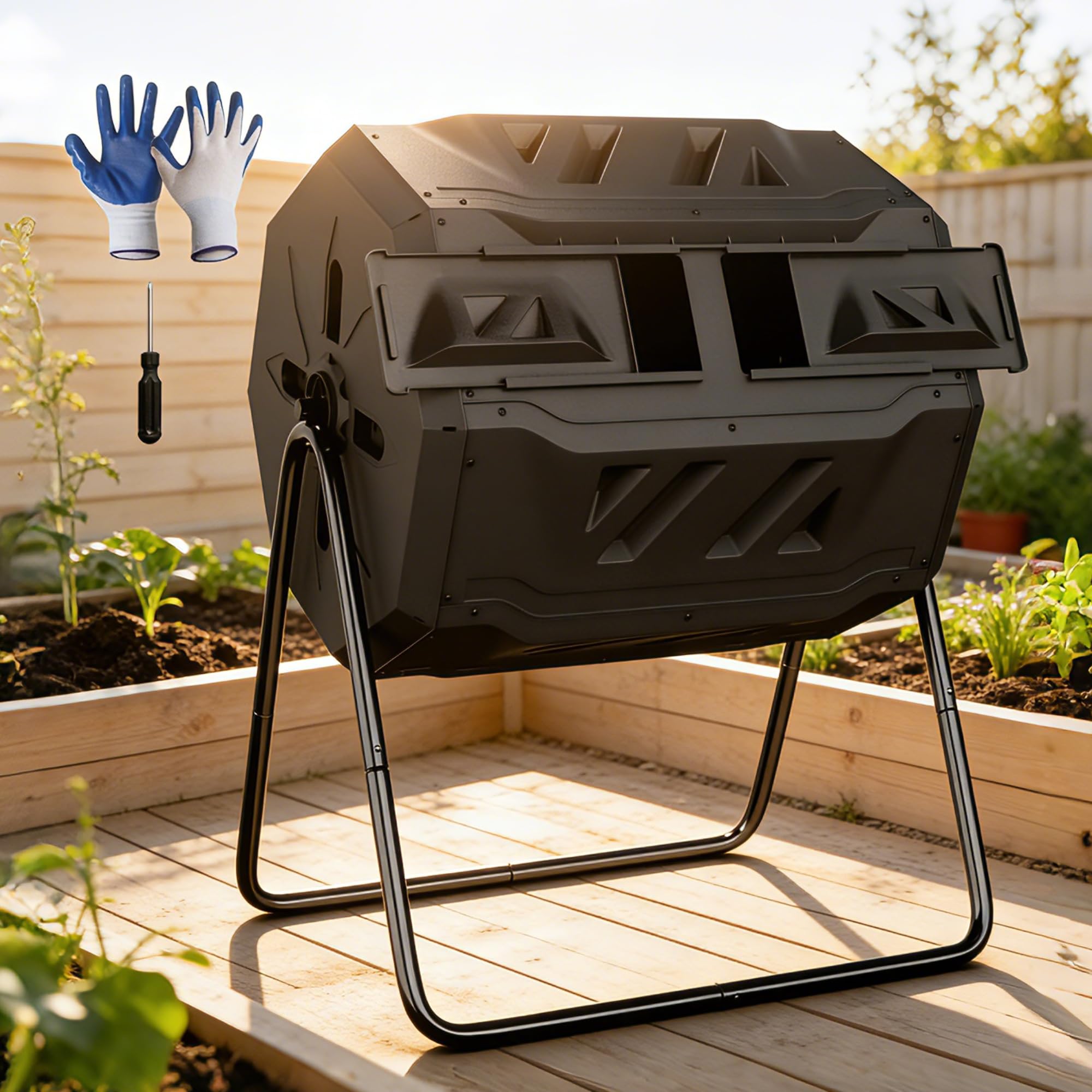
  • Bundled gloves and competitive pricing make it a budget-friendly dual-chamber option — 71 mentions, 89% positive

Cons

  • Assembly can be a time-consuming chore because the instructions are unclear and tiny hardware abounds — 103 mentions, 87% negative on instructions
  • Sliding doors may warp after prolonged sun exposure, causing them to stick and making loading more difficult — 197 mentions, 32% negative

The Nazhura tumbler delivers a functional dual-chamber continuous composting system at a price that includes a pair of gardening gloves. The steel frame and plastic body hold up reasonably well for the cost, and a smaller household’s daily scraps will break down without much hassle. The tradeoff is assembly: the instructions are poorly drawn and unlabeled, and tightening dozens of small screws can be tedious. After months of sun exposure, the sliding doors may warp slightly, making them stiff to open—hardly a dealbreaker, but a reason it lands below our top picks for overall refinement.

Bottom Line: If you’re comfortable with a tedious initial assembly and can situate the tumbler where it won’t bake in full sun all day, the bundled gloves and lower price make this an attractive continuous-composting starter for small to medium households.
#10

Couples

Hourleey 43-Gal Tumbler

Hourleey 43-Gal Tumbler

4.3
  • Type: Dual-chamber tumbler
  • Capacity: 43 gal
  • Pest Resistance: Enclosed
  • Ease of Assembly: Poor instructions, confusing layout
Check Price

Pros

  • Solid quality and sturdy construction for the price — 52 mentions, 94% positive
  • Spins easily and smoothly once assembled — 22 mentions, 95% positive

Cons

  • Assembly is marred by poor instructions and a confusing layout of parts, making setup a test of patience — 138 mentions, 54% negative — many reviews cite the manual as the worst part

The Hourleey tumbler delivers smooth spinning action and sturdy construction for a household of two generating daily kitchen scraps. The dual-chamber design holds 43 gallons, and the metal frame feels solid for the mid-range price. Assembly is the real hurdle — the instruction manual is poorly laid out and demands patience beyond what similar tumblers require. For buyers who prioritize easy turning over quick setup, it’s a capable option, though the similarly priced VIVOSUN alternative offers slightly better refinement and door design once assembled.

Bottom Line: For a two-person household that values easy daily turning and solid build quality over a quick assembly, this Hourleey tumbler fits the bill. Patience during setup is the entry ticket; if you'd rather avoid that, the VIVOSUN alternative is a stronger pick.
#11

Also Great

Pros

  • 94-gallon capacity processes large amounts of yard and food waste without frequent emptying.
  • Constructed from 100% recycled plastic, BPA-free, and made in Canada for an eco-conscious build.

Cons

  • No customer feedback exists to confirm how the plastic and locking lid hold up to weather, critters, or heavy use.
  • Missing price prevents any assessment of value compared to other stationary bins.

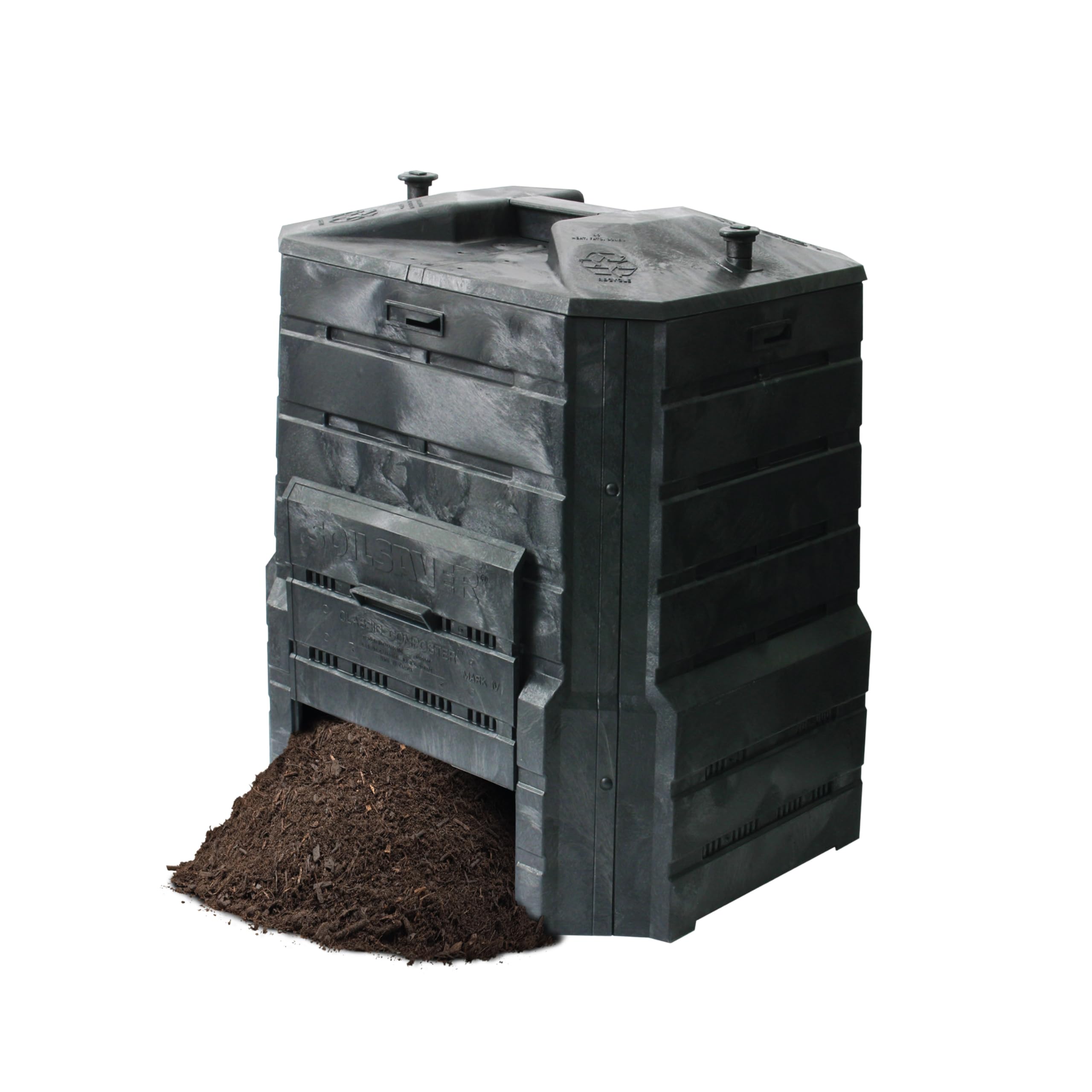
The 94-gallon Algreen Soil Saver uses 100% recycled plastic to contain mountains of yard clippings and kitchen scraps, making it a sustainable choice for ambitious composters. A locking lid and dual sliding doors aim to keep pests out while allowing access to finished compost. Yet with no customer feedback to confirm how the bin holds up over seasons, and no price listed to gauge value, the purchase feels blind for anyone wanting verified durability or a known upfront cost.

Bottom Line: This bin suits buyers willing to research independently across retailers, who prioritize capacity and recycled materials over verified performance data.

How to Choose

Type of Composter

Tumblers speed up decomposition by aerating with each spin, but they require regular turning and can become heavy and hard to move when full. Stationary bins rely on passive breakdown and need manual pile turning or patience; they hold more volume but offer less protection from pests. Worm bins convert kitchen scraps into castings indoors with no odor, yet they can't handle yard waste and demand careful moisture control. Electric composters dehydrate and grind waste quickly on the countertop, but they consume electricity and often have limited capacity.

Capacity

Bigger isn't always better. A 216-gallon bin swallows mountains of leaves but demands a large yard and sturdy staking. A 37-gallon tumbler works for a medium garden, while a 4-liter electric unit fits a small apartment. Overfilling a tumbler makes turning nearly impossible, so match the bin to your daily scrap volume rather than ambitions.

For a family of four producing about two quarts of scraps daily, a 43–65 gallon outdoor bin strikes a practical balance between frequent filling and manageable turning effort.

Ease of Assembly

Nearly every tumbler ships as a flat-pack with dozens of identical-looking screws and baffling instructions. The hidden cost is time and frustration — budget at least an hour, and a second person, even for 'simple' assembly.

If you dread a long build, snap-together stationary bins that go together in minutes with no tools are a far friendlier entry point. Worm bins and electric units skip the hardware ordeal entirely.

Durability of Components

Outdoor bins face UV radiation, rain, and freeze-thaw cycles that slowly make plastic brittle. Tumblers with recycled polypropylene bodies and galvanized steel frames tend to hold up longer, while budget plastics may crack after one season, especially around stress points like axles.

Check that the axle assembly uses metal, not plastic, and that the frame bears the weight rather than the plastic shell. In sunny climates, darker bins absorb more heat, speeding composting but also accelerating plastic degradation — UV-stabilized materials matter.

Aeration and Turning Mechanism

A well-designed tumbler spins with moderate effort even when half-full, thanks to internal fins that break up clumps. Without deep ribs, contents compact into a heavy ball, and turning becomes a strain.

Stationary bins need manual turning with a fork, which is simple but labor-intensive. Worm bins and electric composters sidestep turning entirely, using worms or motorized grinders — ideal for those with limited physical ability.

Pest Resistance

An open-bottom bin invites earthworms up but also gives raccoons and rodents easy access. Sealed tumblers and indoor worm bins are critter-proof, while some stationary bins benefit from a hardware cloth barrier underneath. In suburban areas, raised tumblers with locking lids are the safest bet for keeping pests at bay.

Frequently Asked Questions