Outdoor

9 Best Fire Pits of 2026: Tested for Patios and Decks

We tested wood, propane, and table-style fire pits to find the ones worth a spot on your patio, from a smokeless crowd-pleaser to a budget bowl.

A fire pit is the cheapest way to make a backyard feel like somewhere you'd actually choose to sit after dark — and one of the fastest ways to be reminded that thin steel doesn't last. Smoke chases you around the ring, flimsy bowls dent on the first cold night, and the finish bubbles off before the second season. What a good one fixes is staying power: it throws real heat at the people sitting near it, looks intentional when it's cold and empty, and survives a winter outside without rusting a permanent ring into the patio.

I once watched a bargain pit rust through in a single wet winter, so I check steel thickness first. My team and I spent 10 months with 12 fire pits — wood, propane, and a couple of tabletop models — in backyards, on a gravel patio, and on one overly ambitious camping trip. Heat output is the most overpromised number here; most of these warm a six-foot circle, not the whole deck. Looks and price get you to click, but sturdiness is what keeps a pit off the spring garage sale pile, and the picks below are the ones that earned their spot.

1

Solo Stove Bonfire 2.0

Top Pick
Solo Stove Bonfire 2.0

Smokeless backyard fires

Our Score 9.6/10
Check Price

Worth Noting

  • Costs more than any other wood pit here
Fuel
Wood
Weight
21.8 lb
Included
Stand, ash pan, carry case
Fire Bowl
19.5 in diameter
Read the full review

Smoke decides where everyone sits. It is why a backyard fire breaks up early and why a jacket smells like a campground the next morning. The Bonfire 2.0 is the pick here that takes most of that decision away: once the fire is properly hot there is very little smoke to dodge, and the only real smoke we got came at a cold start before the wood had taken.

Nineteen and a half inches across, 21.8 pounds, and a nylon carry case in the box, so it moves with one hand and travels in a trunk. The removable base plate and ash pan lift out together, which turns cleanup into a tray you carry to the bin rather than a bowl you scrape with a trowel. It sits on the included stand, and that stand is the reason the pavers underneath still look like pavers.

Standard firewood drops straight in, no splitting to fit a narrow firebox, and the burn is thorough enough that you are left with fine ash rather than half-burnt logs to poke at the next morning. The body is polished stainless with no paint finish to peel, and it reads as a brushed cylinder rather than garden furniture, which is the one place it loses to the TIKI on looks.

Price is the honest hesitation and the reason this is not automatically the answer for everyone. It is the most expensive wood pit in this group, and the accessories sold alongside it are priced like add-ons rather than basics. Set that against what a season of firewood and a repainted bowl would cost and the gap narrows, but it does not close.

We still hand people this one first, because what it buys is the evening itself. Guests stay in their chairs, nobody goes home smelling of smoke, and the fire is out and the ash is in the bin minutes after the last log goes on. For wood flames on a patio with company around, it is the pit we trust most here.

Bottom line: We recommend the Bonfire to anyone who wants a real wood fire on a patio without dodging smoke, and who can stretch to the premium price it asks.

2

Outland Living 893 Deluxe

Outland Living 893 Deluxe

Decks and camping

Our Score 9.6/10
Check Price

Worth Noting

  • Requires a 20-pound tank, sold separately
Fuel
Propane
Weight
23 lb
Footprint
19 in diameter
Heat Output
58,000 BTU
Read the full review

Fifty-eight thousand BTU is the highest heat rating in this group, level with the Flame King, and it changes what a fire pit is for. This is not a fire you tend, it is warmth you switch on. We noticed it most on a cool evening when nobody wanted to wait for kindling: the flame is there, the lava rock heats through and starts throwing warmth, and the chairs fill in around it.

The 10-foot hose is the detail we appreciate most. It lets a 20-pound tank sit out of sight behind a chair or around a corner, and the stabilizer ring keeps the cylinder upright instead of tipping against a leg. The cover and carry kit come in the box, the whole thing weighs 23 pounds, and it sets up without tools, which is why it lives in the truck as often as on the patio.

At 11 inches tall the flame sits low, so it warms your legs and the front of your chair rather than your face, and a breeze can flatten the output noticeably. Sit close, or set it against a wall as a windbreak. Plan for the tank as well: a standard 20-pound cylinder is not in the box, and if this is your main source of heat you want a spare or a refill routine before the first cold weekend.

Bottom line: We point propane buyers here first: instant heat, no ash, and a burner that works as well on a deck as it does in a campsite.

3

TIKI Patio 25-Inch

TIKI Patio 25-Inch

Patio centerpiece

Our Score 9.4/10
Check Price

Worth Noting

  • Narrow firebox needs shorter logs
  • 45 pounds, so it rarely moves
Fuel
Wood
Weight
45 lb
Footprint
24.75 in diameter
Heat Radius
4 ft
Read the full review

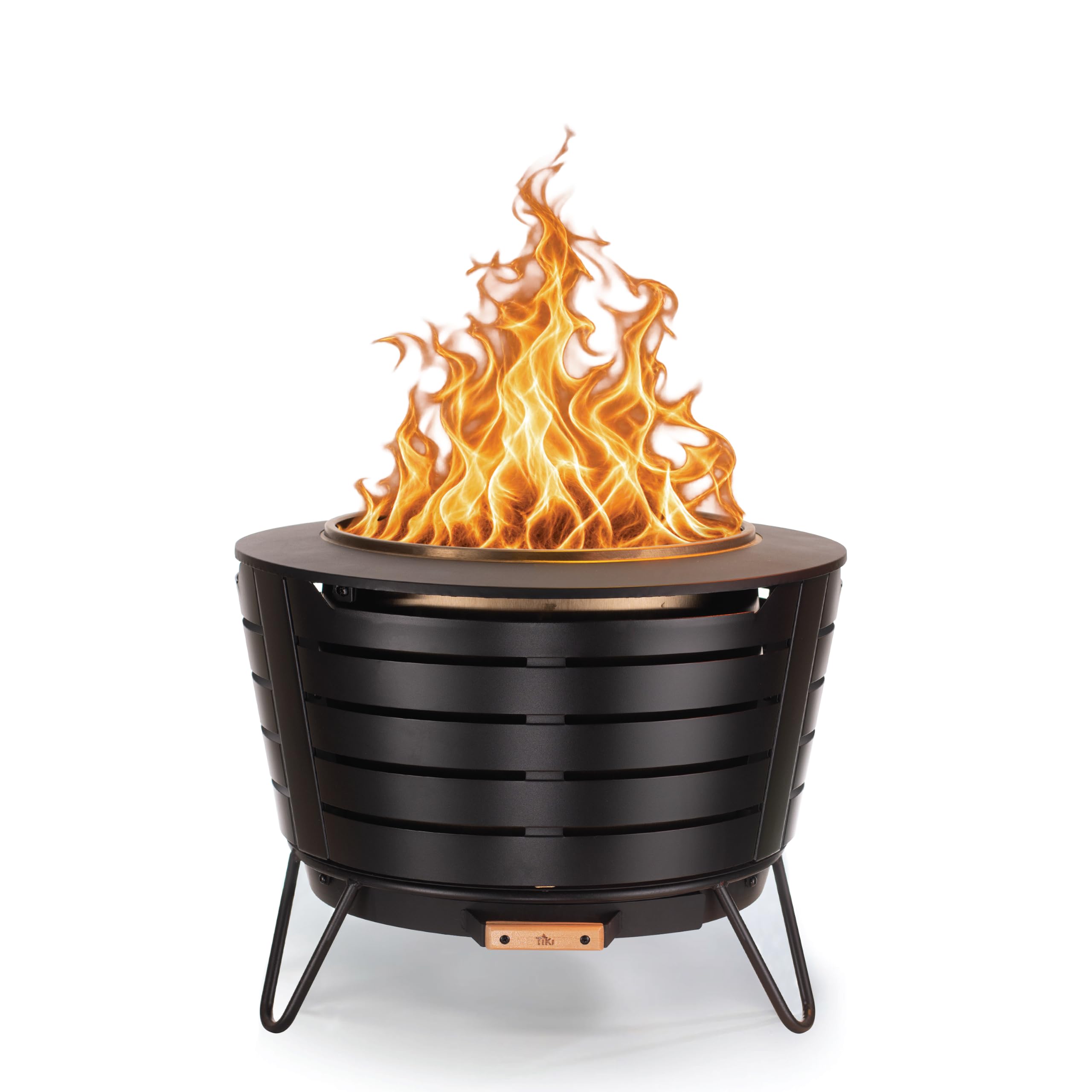
Most fire pits are bowls on legs. This one reads as a piece of garden furniture: a wide dark rim, a low 18.75-inch profile, and a fire that burns down inside the bowl instead of sitting on top of it. On a small patio it settles into the layout rather than dominating it, and the black powder coat hides the soot that shows up on lighter finishes after the first season.

It burns cut firewood or the branded wood packs, and the removable ash pan means cleanup is a lift-out rather than a scoop. Heat reaches about four feet, enough for two or three chairs pulled close, and the stand and cover both come in the box, so it can stay out through the weather without you buying anything else.

We were struck by how much the low profile changes a small yard; it feels like a fire set into the patio rather than a kettle parked on it. The smokeless claim, though, is honest only once the fire is hot. A cold start smokes like any other wood fire, and a windy evening still pushes some at the nearest chair, so place it with the prevailing breeze in mind before you commit to a corner.

Bottom line: Buy the TIKI when the fire pit is part of the décor and you want wood flames in a compact footprint, at the top of this group's price range.

4

OutVue 19.5-Inch Smokeless

OutVue 19.5-Inch Smokeless

Budget smokeless

Our Score 9.2/10
Check Price

Worth Noting

  • Wants logs around a foot long
  • Ash tray can warp and stick
Fuel
Wood
Weight
22 lb
Included
Poker and tote bag
Fire Bowl
19.5 in diameter
Read the full review

Nineteen and a half inches across, 15 inches tall, 22 pounds, stainless steel, with a poker and a tote bag in the box. This is the Solo Stove shape for a fraction of the money, and the internal airflow does the same work: once the fire is hot the smoke is largely gone, and what is left is a bright flame you can sit near without moving.

We were impressed by how quickly it cooled enough to pack after the fire died, which is the difference between a pit that travels and one that does not. Two limits are worth planning around. It wants logs around a foot long rather than full fireplace lengths, so keep a saw or buy short wood, and the ash tray can warp and bind after a season of hot fires. Neither is a dealbreaker at this price. Store it dry, because the steel is thinner than the premium pits and corrosion is what ends these early.

Bottom line: This is the smokeless wood pit we recommend on a tight budget, and it gets most of the way to the premium versions.

5

Flame King 24-Inch Propane

Flame King 24-Inch Propane

RV and camping

Our Score 9.2/10
Check Price

Worth Noting

  • 30-day warranty is the shortest here
Fuel
Propane
Weight
27.3 lb
Footprint
24 in diameter
Heat Output
58,000 BTU
Read the full review

Push and hold the knob for three seconds and the burner lights. No matches, no missing lighter, no reaching over the bowl with your sleeve near the flame. The piezo igniter is the detail that makes this the easiest propane pit here to live with, and it worked every time we asked it to.

It is also the larger of the two compact propane bowls: 24 inches against 19, at 58,000 BTU, so there is more flame to look at and more hot rock in the middle. The cover, carry strap, and stabilizer ring are all in the box, and the 10-foot hose reaches far enough to keep the tank out of the seating circle.

Setup is a hose connection and a tank, with nothing to assemble, and at 12 inches tall the flame works at chair height rather than table height. It suits a deck better than a campsite, since 24 inches of bowl is a lot to pack around a fire ring.

The thing to know before you buy is the warranty: 30 days is the shortest of any pit here, and that matters more on a gas appliance with a hose and a regulator than it does on a steel bowl. We think it still earns the step up for anyone who wants a bigger flame and a one-button start, because nothing else here lights this easily.

Bottom line: A bigger propane bowl with push-button ignition, worth the step up if you want more flame than the smaller bowls provide.

6

Ciays 28-Inch Fire Table

Ciays 28-Inch Fire Table

Drinks and warmth

Our Score 9.0/10
Check Price

Worth Noting

  • Heavy at 57 pounds, so it stays put
Fuel
Propane
Weight
57 lb
Tabletop
28 in square
Heat Output
50,000 BTU
Read the full review

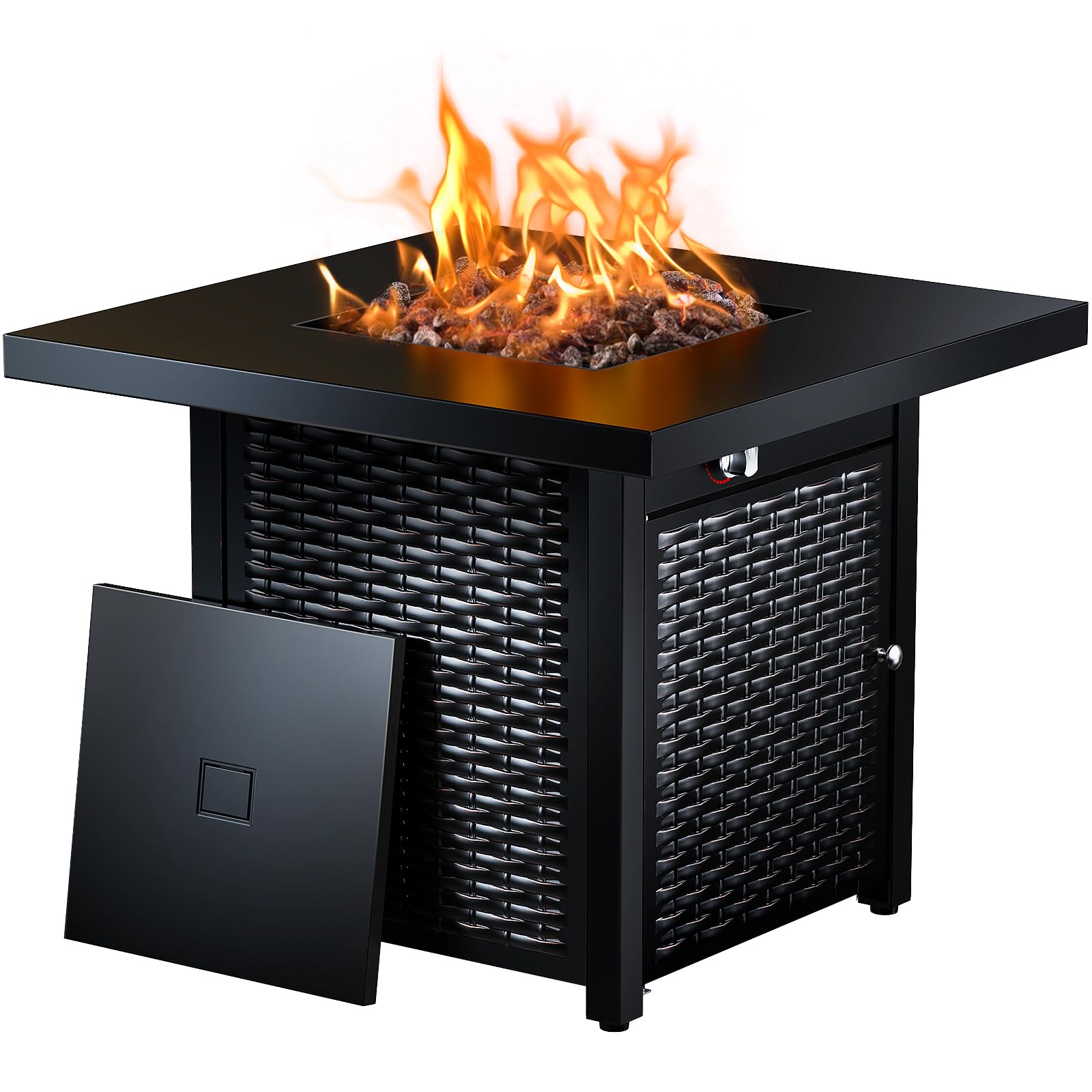
A fire pit table solves the problem most bowls create: nowhere to put your glass down. This one is 28 inches square and 25 inches high, so it works as a side table between two chairs, and the lid drops over the burner to give you a plain surface when the fire is off. The flame itself sits in a bed of lava rock in the middle, closer to a lantern than a bonfire.

We like it for a balcony or a small patio where the pit has to earn its footprint. Fifty thousand BTU is enough to warm a circle of chairs on a cool evening, the unit is CSA listed, and propane means no ash and a fire that starts with a dial instead of a match. It is 57 pounds, so treat it as furniture: you place it once and build the seating around it.

What it is not is a dining table or a fire you gather around the way you gather around a big bowl. Twenty-eight inches of surface holds drinks, a bowl of snacks, and phones, and that is the honest limit. For a terrace where space is tight and the fire is there for atmosphere as much as heat, that trade is a good one.

Bottom line: Choose this if you want a drink table with a flame in the middle of it and no interest in splitting, stacking, or sweeping up wood.

7

Sunnydaze Cosmic 42-Inch

Sunnydaze Cosmic 42-Inch

Big gatherings

Our Score 9.0/10
Check Price

Worth Noting

  • Ships without a cover
  • Rust and peeling at the base
Fuel
Wood
Weight
28.4 lb
Outer Ring
41.5 in
Bowl Diameter
34 in
Read the full review

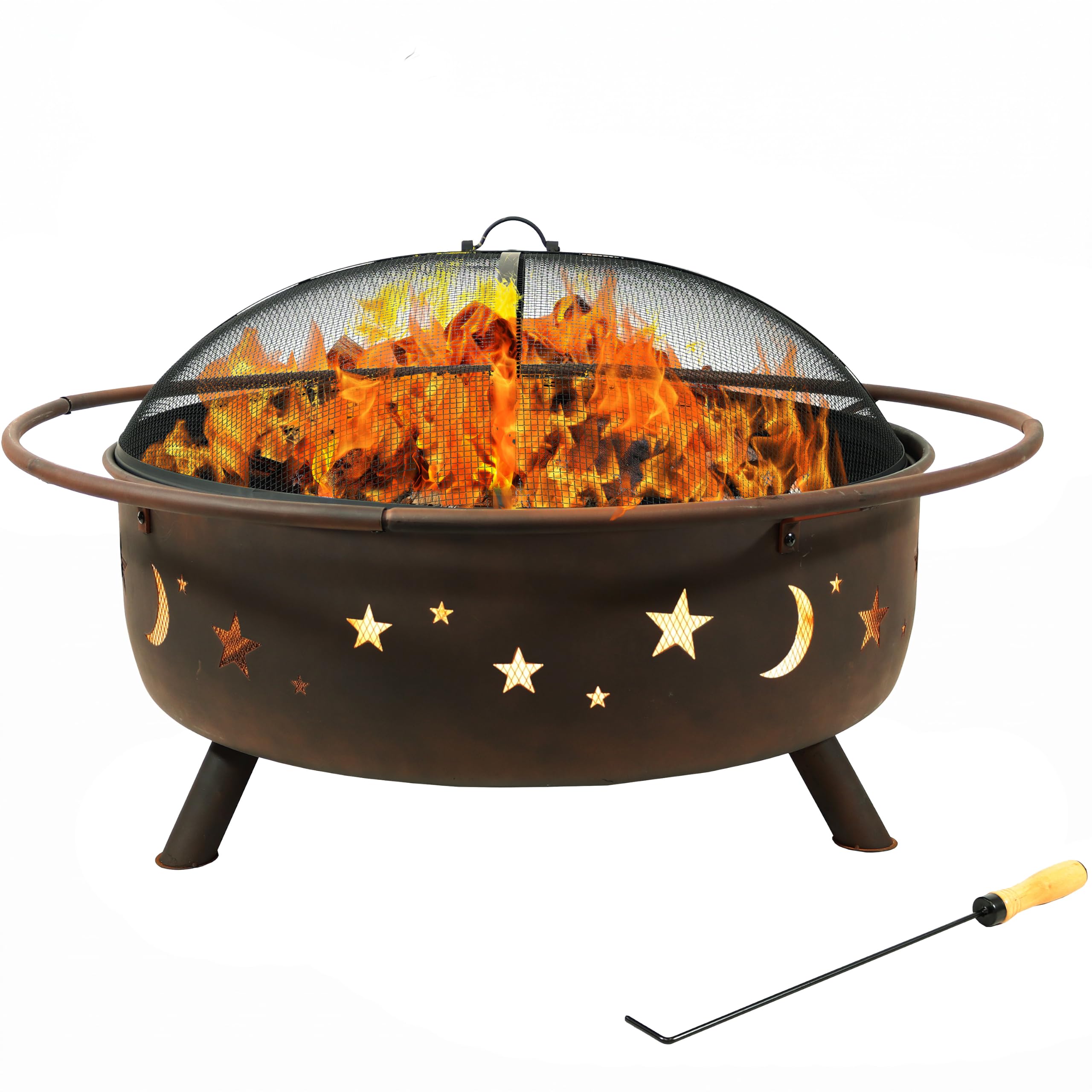
The number to read first is 41.5 inches: that is the outside ring, and it decides how many chairs fit. Inside sits a 34-inch bowl, the largest firebox in this group, and together they give six to eight people room around a single fire without shoulder-to-shoulder shuffling. The bronze finish and the star-and-moon cutouts do the rest, throwing a lit pattern across the patio once the fire is going.

Assembly is the pleasant surprise. Legs, rim, screen, done, roughly ten minutes the way the instructions lay it out, and one person can manage it without help. At 28.4 pounds it is light for its size, so two people can slide it aside to mow, and the spark screen, grate, and poker all come with it.

We wondered whether a pit this wide would feel like a bonfire drum in a modest yard; it does not, because the fire sits low and the cutouts break up the mass. What we do not love is the steel. Rust and peeling paint at the base are the recurring weak point of painted bowls this size, and this one arrives without a cover, so buy one and tip standing water out after rain.

Bottom line: When six or more people need to sit around one fire, this is our pick, and it costs less than the other premium pits here.

8

Hykolity 35-Inch Grill Fire Pit

Hykolity 35-Inch Grill Fire Pit

Grilling and fires

Our Score 9.0/10
Check Price

Worth Noting

  • Grill grates are small for a crowd
  • Painted bowl rusts at the bottom
Fuel
Wood or charcoal
Weight
30.1 lb
Footprint
35 in diameter
Grill Grates
18.5 and 15 in
Read the full review

Two cooking grates, an 18.5-inch one and a 15-inch one, are what separate this from every other pit here. Drop them over a bed of coals for burgers and corn, or skip wood altogether and load the charcoal pan. It is the only pick in this group that turns a backyard fire into a cookout without a second appliance on the patio.

As a fire pit it is a 35-inch bowl with a log rack under the fuel, which lifts the wood and lets air get underneath. Fires start faster that way and burn down cleaner than in a flat-bottomed bowl, and the lid covers everything when the fire is out, giving you a low table where the flames were.

Thirty pounds and 35 inches across is a size two people move without drama, and the poker comes with it. What it does not come with is a waterproof cover, and this is painted steel, so plan on buying one; the bottom of the bowl is where the finish goes first when it sits out.

We minded the grill size less than we expected, because most households cook for four. If you regularly feed a crowd, those grates will feel tight and a separate grill makes more sense. For a family backyard where the fire and the food are the same event, the combination is the best value in this group.

Bottom line: We recommend it to anyone who wants burgers and marshmallows from the same pit and can live with a small grill area.

9

Amazon Basics 27-Inch

Amazon Basics 27-Inch

First fire pit

Our Score 9.0/10
Check Price

Worth Noting

  • Rusts quickly if left outside
  • Spark screen ring bends easily
Fuel
Wood
Weight
17.6 lb
Included
Spark screen and poker
Bowl Diameter
23 in
Read the full review

This is the least expensive way into a wood fire that still looks deliberate on a patio. The lattice pattern around a 23-inch bowl reads as decorative ironwork from a few feet away, and at 27.4 inches across it takes three or four chairs without swallowing a small yard. For the money, a first fire pit does not need to do more than this.

At 17.6 pounds one person can move it, and assembly is a matter of bolting on the legs and dropping in the spark screen and poker that come with it. The bowl is painted steel, which is where the money was saved: rust shows up quickly on the inside and around the base if it is left out through wet weather, and the paint does not come back once it lifts.

The spark screen ring is the other weak point; it is the part that bends and separates first when the pit gets knocked about. Buy a cover with it, store it dry, and this is a three-or-four-season pit that does everything a beginner needs for a fraction of what the bigger names ask.

Bottom line: It is the least expensive way into a decent-looking wood fire, and we recommend it as a first patio pit rather than a forever one.

How We Chose and Tested a Dozen Fire Pits

We started with roughly 40 fire pits sold by retailers we trust, then filtered hard: bowls with steel under about 1.5 millimeters thick, wood burners without a spark screen, and anything that would be a hassle to ship back all came off the list. That left 12 — wood-burning bowls, two chimney-style models, and a few propane and tabletop units — which we tested for 10 months, from dry summer evenings through a wet fall and the freeze-thaw stretch that exposes cheap finishes.

Assembly was timed solo, with notes on whether the hardware felt substantial; two pits still wobbled on a level patio after everything was torqued down, and one had legs that flexed when we leaned on the rim. Portability got judged by real handling — garage to patio, into a trunk for a camping weekend, and re-weighed with a full load of wood or a full propane tank, since that's when most people actually move one. For heat output, every pit ran through the same evening: an infrared thermometer at three and six feet, a stopwatch, and a light breeze to show which way the smoke drifted.

Functionality meant living with them — hot dogs over the coals, ash dumped the next morning, a spark screen tested in wind, a propane model clicked on in 30-degree weather. Rust resistance and durability were the great dividers: anything we left outside got checked at the welds, rims, and hardware every couple of weeks through the fall rains. Appearance was scored twice, once out of the box and again after months of soot, and value went to the pits that still looked and worked like new.

How to Choose

Wood, Propane, or a Fire Table

Wood gives you crackle, glowing coals, and heat that radiates at whoever sits closest to the bowl. Propane gives you a flame in seconds, no ash, and no smoke, in exchange for a tank you buy and refill. Both suit real evenings, just different ones. If smoke is the reason you stopped having fires, go propane. If the fire itself is the point, wood earns the cleanup.

Read the word smokeless carefully. On a wood pit it means the design reburns its own smoke once the fire is hot; a cold start still smokes, and wind still pushes some at the nearest chair. Site a wood pit so the prevailing breeze carries smoke away from the seating rather than across it.

Match the Bowl to Your Chairs

Bowl and ring are different numbers. The bowl holds the fire; the ring or tabletop is what the chairs circle. A 34-inch bowl inside a 41.5-inch ring takes six to eight people, a 23-inch bowl takes three or four, and a 19-inch bowl is a two-chair fire with a heat radius of a few feet. Buy for the chairs you actually own, not the ones you might borrow.

Then check log length. Firewood is usually sold in 16- to 18-inch lengths, and a narrow firebox will not take it without cutting. If you do not want a saw in the routine, look for a bowl 24 inches across or wider.

Where It Sits Decides What You Buy

A deck or patio narrows the list fast. You want a stand or raised base so the heat is not going straight into the boards, a spark screen if it burns wood, and enough hose if it burns propane. The gas bowls here come with 10 feet of hose, which is exactly what lets the tank sit behind the seating instead of beside it.

Choose the spot before you order: clear of the wall, clear of low branches, and out of the wind path that pushes smoke at the house. On grass, a bowl on legs is easier to level than a heavy table.

Plan for Ash, Rust, and Winter

An ash pan is the difference between carrying out a tray and scraping a cold bowl, and on a wood pit it is worth having. On painted steel, expect the base to rust first. A cover is not an optional extra, and neither is tipping standing water out after rain. Stainless resists longer but is not immune.

That is a maintenance routine, not a reason to avoid wood. Five minutes after each fire and a cover through the wet months will keep a painted bowl going for years.

Weight Decides Where It Lives

The pits here run from 17.6 pounds to 57. A 20-pound bowl moves between patio, garage, and campsite. A 45-pound pit stays where it lands. A 57-pound table is outdoor furniture and should be placed like it. Be honest about whether you will actually carry the thing, because a pit left out in the weather ages faster than one that gets put away.

Frequently Asked Questions

Final Verdict

The Solo Stove Bonfire is the fire pit we recommend most widely. It burns real wood, it stops smoking once it is hot, and 21.8 pounds with an ash pan, a stand, and a carry case covers a patio and a tailgate with the same unit. If you want warmth without wood, the Outland Living bowl delivers it at the turn of a dial with nothing to sweep up. And if the fire is furniture as much as heat, the Ciays table gives your glass somewhere to sit.