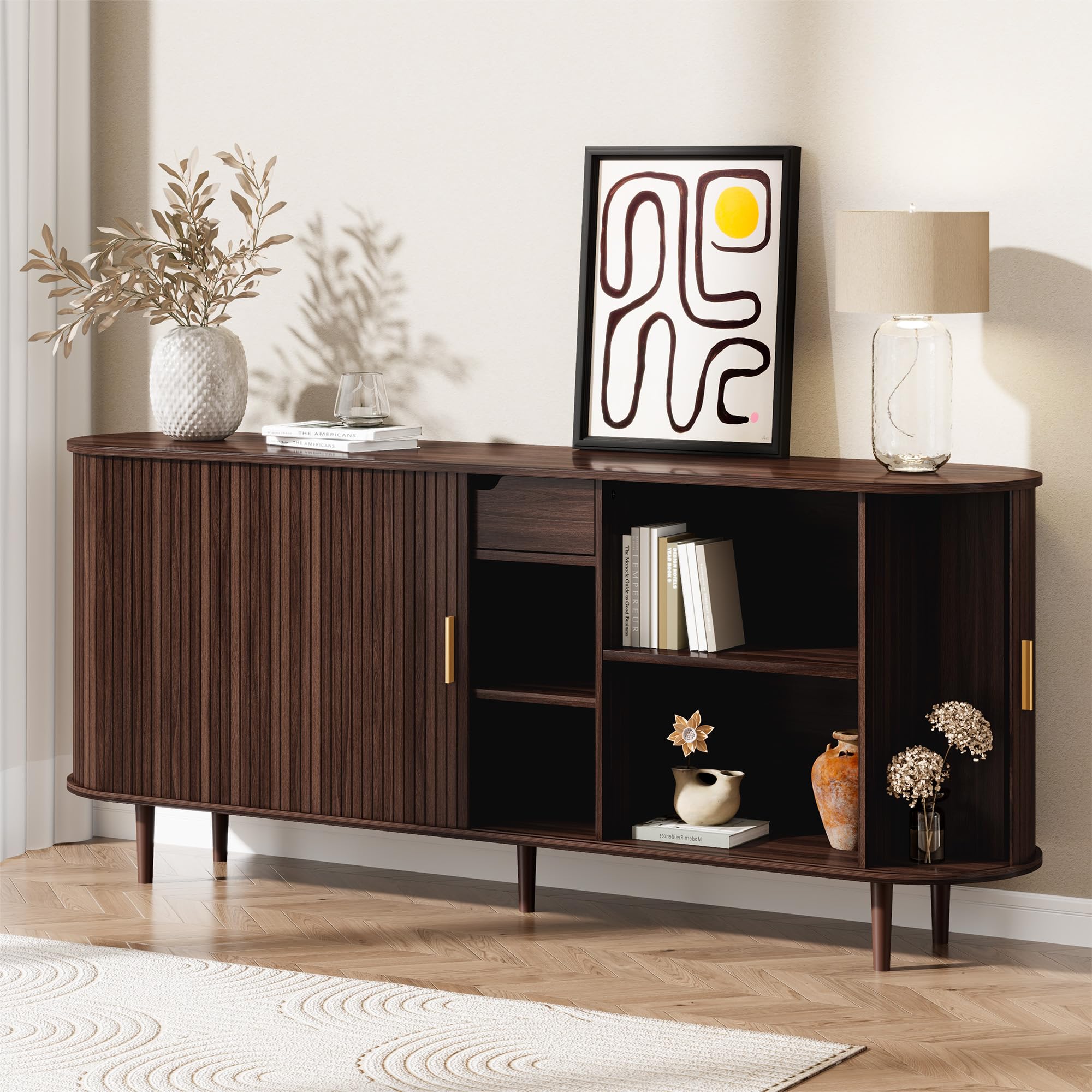
Furniture

8 Best Credenzas 2026: 8 Sideboards Worth Buying

We tested credenzas for living rooms, dining rooms and entryways. The sideboards we recommend for small spaces, long walls, coffee bars and real wood.

A credenza has one job that sounds simple and isn’t: hold a room together without looking like a storage unit. I’ve learned that the pretty ones can arrive with doors that rub, the sturdy ones can smell like a lumber yard for a week, and the flat-pack bargains can eat an entire Saturday. What you’re really buying is calm — a place where the clutter disappears, the TV components breathe, and the surface still looks intentional. That balance of appearance, storage, and sturdiness is the whole game.

Over eight months, I lived with six credenzas — building them, filling them with books and barware, and yes, sniffing the shelves after unboxing. I noted which doors lined up and closed cleanly, how the finish held up to keys and mugs, and whether the drawers still felt solid once loaded. I also measured each one against tight hallway turns and checked that cords and consoles fit behind the back panel. None were perfect, but the ones below earned their place for different rooms and budgets.

1

Bme Georgina Solid Wood Sideboard

Top Pick
Bme Georgina Solid Wood Sideboard

Solid wood buyers

Our Score 9.6/10
Check Price

Worth Noting

  • Premium price compared with the rest of the set
Storage
2 doors, 3 drawers
Material
Solid acacia wood
Max Load
254 lb
Overall Dimensions
16"D x 61"W x 29"H
Read the full review

Ten minutes with a screwdriver is the whole assembly: the carcass arrives built and you bolt on four matte black legs. After a run of flat-pack evenings, that felt like a luxury. What sits on those legs is solid acacia with a carved geometric pattern across the doors, and it reads as the most expensive thing in the room — heavy, warm-toned, and finished inside as well as out.

At 61 inches wide, 16 deep and 29 tall, it lands in media-console territory, and the layout is the most useful in this group: two doors hiding adjustable, removable shelves, plus three drawers for the small clutter that otherwise migrates to the top. Soft-close hinges and magnetic catches mean the doors settle instead of banging shut, which matters more than it sounds in a room where people are in and out of the cabinet all day.

Two things to plan for. At 97 pounds it arrives as one box, so line up a second person and clear the path before you open it — this is not a piece you walk up the stairs alone. And acacia moves with the seasons the way real timber does, so run your hands over the panels and drawer fronts inside the 30-day return window rather than after it, with the one-year warranty as the backstop.

Bottom line: We recommend it to anyone who wants real wood and a ten-minute setup: the acacia frame, soft-close doors and carved pattern justify the splurge on a piece you plan to keep.

2

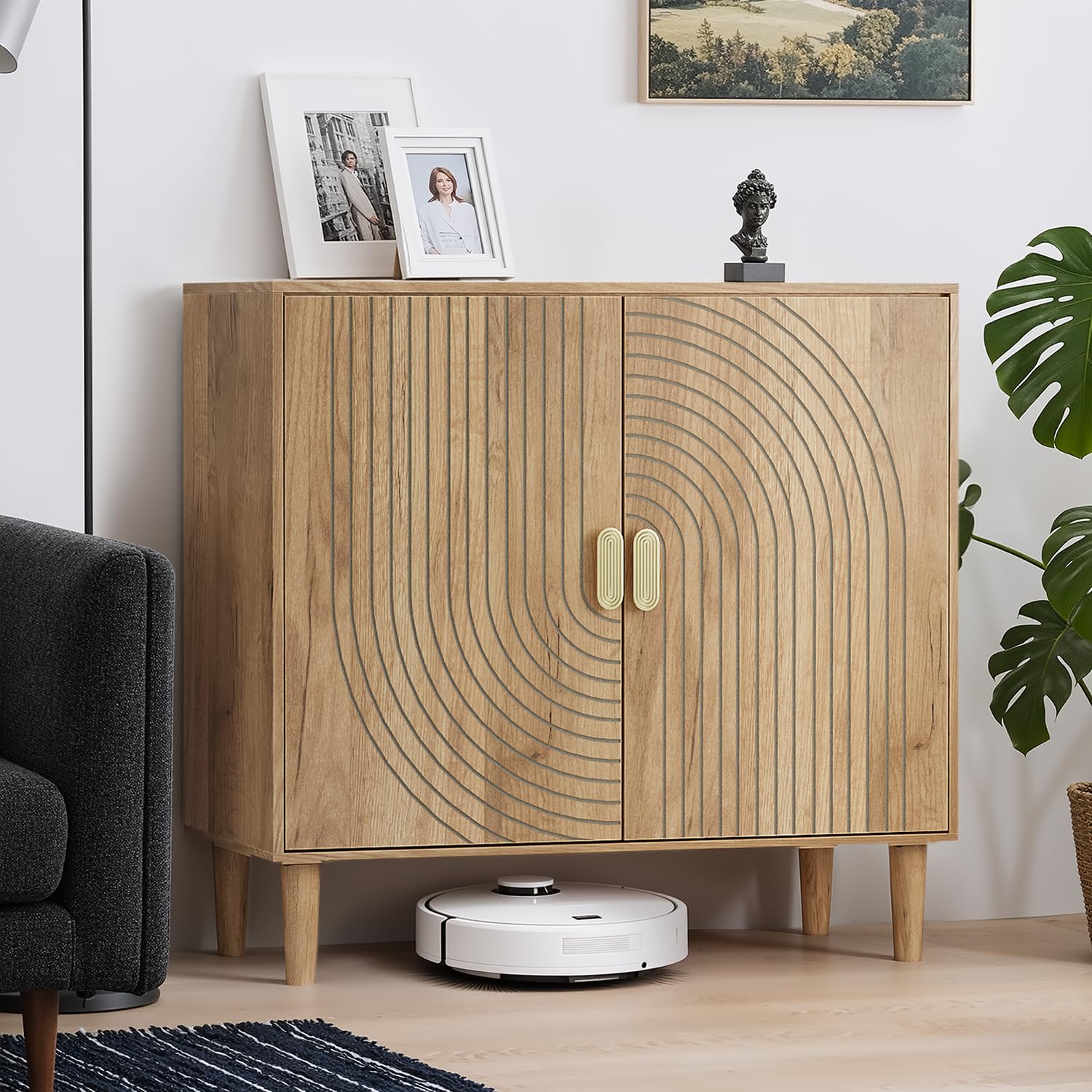
ONBRILL 55" Sliding Door Sideboard

ONBRILL 55" Sliding Door Sideboard

Living and dining rooms

Our Score 9.2/10
Check Price

Worth Noting

  • Low 29.5-inch top is awkward for serving
Doors
2 sliding
Shelves
1 fixed, 2 adjustable
Material
Engineered wood, walnut finish
Overall Dimensions
15.8"D x 55.1"W x 29.5"H
Read the full review

A 55-inch sideboard is the hardest piece to place in a small house, because it wants a couple of feet of clear floor in front of it and the room doesn't have them. ONBRILL solves that with two panels on a top and bottom track, so the doors travel sideways across the face instead of swinging into the walkway. In a dining room where chairs already pull out, or an entry where the front door sweeps in, that single decision is the difference between a cabinet that works and one you negotiate with every morning.

We made it the default because it does the most jobs for less than most of this group: buffet in the dining room, bar replacement in the living room, drop zone by the door. At 15.8 inches deep it stays out of traffic, and 29.5 inches tall puts the top just under the back of a typical sofa — exactly where a lamp, a stack of books and a couple of frames want to sit anyway.

Inside, a fixed shelf runs across the middle with an adjustable shelf at each end, and the depth is the useful part: a wine rack or a run of dinner plates fits without the door catching on them. We also noticed the details that usually get skipped at this end of the market — wood handles rather than plastic pulls, a walnut finish with actual grain tone instead of a printed pattern, and a closed back that keeps the piece looking finished from the side.

The sliding hardware is the part to watch. Panels on a cabinet that goes together slightly out of square will drag, and a floor that isn't level makes it worse. Assemble it on a flat surface, keep the track screws loose until both panels are seated, and give each one a firm pull rather than a nudge. That's a small tax on an otherwise easy recommendation.

Bottom line: Our pick for most living and dining rooms: sliding doors save the floor space a swinging cabinet eats, the walnut finish looks costlier than it is, and the interior swallows a full bar setup.

3

Smuxee Oak Sideboard Cabinet

Smuxee Oak Sideboard Cabinet

Small spaces

Our Score 9.2/10
Check Price

Worth Noting

  • Shallow 14.9-inch interior
Doors
2
Shelf
Adjustable, 3 heights
Weight
43.2 lb
Overall Dimensions
14.9"D x 31.5"W x 30.6"H
Read the full review

One of these is a small cabinet; two of them, set side by side, read as a single long credenza with a break in the middle that looks deliberate. That's the trick with the Smuxee. At 31.5 inches wide it slots into a hallway, a stair landing, or the sliver of wall beside a fireplace, and the line-groove doors give it enough texture that it doesn't look like a gap filler.

It's light enough at 43.2 pounds that one person can shift it after assembly, and the shelf adjusts to three heights, so a tall basket or a stack of board games both work. Assembly is a single straightforward session, and the holes are drilled straight — that last part is what usually goes wrong on cabinets this cheap, and it's why we're comfortable sending a first-time buyer here.

Bottom line: We keep this one in mind for small spaces: at 31.5 inches it fits a hallway wall, and two pushed together read as one long credenza for a fraction of the usual spend.

4

DHH 71" Sliding Door Credenza

DHH 71" Sliding Door Credenza

Wide low walls

Our Score 9.2/10
Check Price

Worth Noting

  • Only one drawer for small items
Doors
2 sliding
Drawers
1
Compartments
8
Overall Dimensions
15.75"D x 70.8"W x 29.53"H
Read the full review

Seventy-one inches is the awkward middle of the credenza world: too long for a two-door cabinet to look intentional, too short to read as a wall unit. DHH solves it with sliding panels that cover the whole span, plus a single drawer in the middle and eight compartments behind, so the front stays clean whether you're storing a bar, a record collection or the contents of a hallway closet. Next to the ONBRILL, it's the same idea with another 16 inches of wall.

At 29.53 inches tall it lines up with sofa backs, which makes it a natural media console — low enough that the screen sits at eye level from the couch, long enough that a 65-inch television doesn't overhang the ends. The walnut finish is even across the top, and the solid wood legs lift the base off the carpet so the vacuum reaches under it.

Assembly is where it surprised us. The panels are numbered, the holes are drilled straight, and the illustrations are good enough that we stopped double-checking every step. That's rare at this size, and it's why the cabinet feels more solid than engineered wood usually does: nothing is fighting itself when it goes together.

What it asks in return is patience on moving day. Ninety-five pounds arrives in one long carton, and a 71-inch box does not turn a corner the way the cabinet will. Measure the stairwell and the door swing before it ships, then leave the packaging in the garage for a week in case you change your mind about the wall.

Bottom line: We suggest it for a wide wall and a low profile: 71 inches of sliding-door storage that never asks for swing space, in a walnut finish that suits a media setup.

5

HITHOS 54" Swing-Rack Buffet

HITHOS 54" Swing-Rack Buffet

Coffee bar setups

Our Score 9.0/10
Check Price

Worth Noting

  • Assembly takes a long evening
Doors
2 with swing-out racks
Drawers
1
Max Load
450 lb
Overall Dimensions
15.7"D x 54.3"W x 33"H
Read the full review

The doors are the storage. Each one swings out on a rack with three shallow shelves — the sort of thing that usually shows up in a pantry cabinet, not a credenza — and it turns the deadest space in the piece into somewhere to line up spice jars, syrup bottles or the tea tin collection. Behind the racks there's a full-width compartment with an adjustable shelf and a single drawer above it.

That's why we rate it as the coffee-bar cabinet of this group: everything you reach for in the morning is on a door that comes to you, and the 450-pound top rating means the espresso machine and a microwave can share the surface. The green is deep enough to read as an actual color choice rather than a neutral, the silver pulls stay out of the way, and at 54.3 inches wide it fits where a 60 won't.

Loading it takes a little thought. The racks eat depth, so tall bottles and cereal boxes move to the middle of the cabinet while the door shelves take the short stuff, and a fully loaded rack changes how the door swings. Plan the load before you fill it, not after — and keep the heavier bottles low so the cabinet stays planted.

Bottom line: We like it best as a coffee bar: swing-out racks in both doors put syrups and spice jars in reach, and the deep green finish carries a plain kitchen wall.

6

HOSTACK 60" Tall Buffet Cabinet

HOSTACK 60" Tall Buffet Cabinet

Counter-height storage

Our Score 8.8/10
Check Price

Worth Noting

  • Fixed cupboard shelves won't take tall items
Storage
4 doors, 4 drawers
Material
MDF wood
Max Load
450 lb
Overall Dimensions
15.75"D x 60"W x 36.02"H
Read the full review

Thirty-six inches doesn't sound dramatic until you stand next to it. Most credenzas here land around 30, which is sofa-back height; this one is counter height, so the top becomes a surface you work on rather than one you look at. Coffee station, serving run for a dinner party, the place the mail lands — all of it works better four to six inches higher.

The layout matches the height. Four drawers run across the top for cutlery, batteries and candles, with four cupboards below for the bulky stuff, and the top is rated to 450 pounds — the highest in this set — so a large television or a shelf of cookbooks is not a question. It's 60 inches wide, 15.75 inches deep, and the white with gold pulls keeps a small dining room from feeling like a furniture showroom.

Where it gives ground is the joints. Door and drawer alignment is the weak spot here, and it's the one thing separating a cabinet that looks custom from one that looks assembled. Build it on a hard flat floor, leave every hinge and drawer slide loose until the carcass is square, then tighten and adjust in small turns. Do that and you have a tall, heavy-duty storage wall for less than the solid-wood picks.

Bottom line: We point anyone who wants a working surface to this one: 36 inches tall, four drawers, four cupboards and a 450-pound top that takes a coffee station or a serving run.

7

IFGET 92" Modular Fluted Sideboard

IFGET 92" Modular Fluted Sideboard

Long open walls

Our Score 8.8/10
Check Price

Worth Noting

  • Two packages can arrive on separate days
  • Needs more than seven and a half feet of wall
Doors
6
Pieces
3 modular cabinets
Base Clearance
5.7 inches
Overall Dimensions
15.75"D x 92.63"W x 34"H
Read the full review

Ninety-two inches of credenza is a commitment, and most cabinets that long are one enormous box you'll never move again. IFGET ships three separate units, each with fluted arched doors that throw a soft shadow pattern across the front, and you can line them up as one continuous run or split them across two rooms. On the long blank wall behind a sofa, three of them finally make the proportions work.

The base sits 5.7 inches off the floor, enough for a robot vacuum to pass underneath without rerouting, and the doors are solid arches rather than glass, so what's inside stays inside. Each unit has an adjustable shelf, and the finish is even across all three, which is not a given when a set ships in two cartons.

Plan for the delivery. The three cabinets arrive in two packages that can land on different days, and the protective film wants to come off slowly — pull it fast at a corner and it can lift finish with it. Assembly itself is a one-person job per unit; the first takes the longest, and the third goes together quickly once you know the sequence.

Between this and a single 92-inch cabinet, we take the modules. You can carry each box yourself, you can reconfigure them when you move, and if one unit takes a knock you replace a third of the wall instead of all of it. What no one can promise is that six doors hang perfectly straight out of the box — arched panels on three separate carcasses are the fiddliest alignment job here, and the seams show it if you rush. Level the three carcasses to each other first, then hang doors.

Bottom line: Our choice for a long, empty wall: three modular cabinets span more than seven and a half feet, and the fluted arches do the decorating a blank room was missing.

8

RoyalCraft 58" Painted Buffet

RoyalCraft 58" Painted Buffet

Color-led rooms

Our Score 8.8/10
Check Price

Worth Noting

  • 200-pound top rating is the lowest of the wide picks
Doors
4
Material
MDF, solid wood legs
Max Load
200 lb
Overall Dimensions
16"D x 58"W x 31"H
Read the full review

Paint is where this one earns its place. The green is a flat, saturated mid-century tone rather than the sage that has been on every wall for five years, the bronze handles are cast rather than stamped, and the whole thing sits on solid wood legs that lift it off the carpet. In a room of neutrals it does the work a piece of art would, and it does it while holding the plates.

Under the finish it's MDF with a baked-on, water-resistant surface, which is the right call for a sideboard that will host drippy plants, a drinks tray and whatever the kids put down on their way past. The shelves are thickened and adjustable, there's a center support leg under the 58-inch span, and an anti-tip kit comes in the box.

We recommend it to anyone whose room needs the color decision made for it, with one caveat we keep coming back to: four painted doors are harder to hang evenly than two. This one arrives wanting adjustment, and the finish shows a screwdriver slip, so pad your tools. Get them straight and the seams all but disappear; leave them crooked and you'll notice nothing else.

The other number worth weighing is the top. It's rated lower than the other wide cabinets here, so if the surface is going to carry a television, a stone lamp and a row of hardbacks, add that up before you commit and look at the HOSTACK or the DHH instead. For plates, glassware and a bowl of fruit, the rating never comes into it.

Bottom line: We reach for this one when a room needs color: saturated green paint, carved bronze handles and solid wood legs, all for less than the solid-wood and modular picks.

How We Tested Credenzas for Real Living Rooms

We started by collecting credenzas that were actually in stock, then narrowed the field by dimensions, materials, storage layout, and assembly requirements. We ruled out anything that wouldn’t clear a standard doorway or leave room for cords and a media box behind the back panel. The final six came from big-box names and smaller furniture studios, and they ranged from ready-to-assemble to fully built.

Each one was assembled in a living room or dining room, with two people when the instructions demanded it and solo when they didn’t. We timed the build, noted whether the hardware lined up without force, and checked door alignment right after assembly and again after a week of daily use. We also lived with the smell: some pieces off-gassed for days, while others were neutral by the second morning.

For eight months, those credenzas held records, barware, board games, and a media console, and we opened and closed every door and drawer dozens of times a day. We watched for sagging shelves, bubbling veneer, loose hinges, and drawers that began to scrape, and we checked whether doors still closed flush once the piece was loaded. We looked at the finish in daylight and lamplight, leaned on each piece the way a guest might, and judged value by how well the hardware and surfaces held up after cleaning and shuffling.

How to Choose

Start with the wall and the walkway

Credenzas here run from 31.5 to 92.6 inches wide, while depth barely moves — 14.9 to 16 inches on nearly every one. That's the point of the shape: it hugs a wall and leaves the floor to you. Tape the footprint on the floor before you order, then open a door inside the tape outline and see what it hits. If the outline crowds a chair pull-out or a doorway, go narrower or switch to sliding doors. Compact in a listing describes the cabinet, not the walk to your front door.

Pick the height around what the top will do

Height decides what the top can do. At 29 to 30 inches, a credenza sits just under the back of most sofas — the right zone for a media console, a lamp and a clear view across the room. The 33-to-34-inch cabinets land at bar or serving height for a standing host. Past 36 inches you're at counter height, which turns the top into a coffee station or a place to fold laundry. Choose the number from the job and the room, not from the photograph.

Swinging doors need floor; sliding doors need a square cabinet

Hinged doors on a 55-inch cabinet can need close to two feet of clear floor when they swing, which many dining rooms can't spare. Sliding panels ask for none of that, but they ride a track, so a carcass that goes together slightly out of square will drag and stick. Hinged doors fail differently: they hang on adjustable hinges, and a screwdriver fixes most misalignment. Either way, assemble on a hard, flat floor, keep the hardware loose until the last panel is on, then square the whole thing and tighten.

Match the inside to what you're storing

Drawers take the small, awkward things — cutlery, batteries, candles — and several of these cabinets have one or none, so count them before you commit to a finish. Adjustable shelves matter more than shelf count, because a single fixed shelf at the wrong height wastes a whole compartment; measure your tallest bottle, stockpot or record crate against the clear space. Swing-out door racks, like the ones on the HITHOS, turn a door into storage but take depth away from whatever sits behind it.

Engineered wood, solid wood, and the load on top

Almost everything here is engineered wood, and the number that separates the field is the stated top load, which runs from 100 to 450 pounds. That figure tells you whether a large TV, a stone lamp and a row of cookbooks are reasonable, or whether you're asking too much of a thin panel. Solid acacia costs more and arrives almost built; flat-pack takes an evening and a second pair of hands. Whatever you buy, use the anti-tip kit — a 60-inch cabinet full of dishes is worth strapping to a stud.

Frequently Asked Questions

Final Verdict

Our default is the ONBRILL 55-inch sideboard. It costs less than most of this group, needs no room for doors to swing, and the interior handles a bar, a buffet or a media setup without apologies.

Want the top at counter height with four drawers under it? The HOSTACK 60-inch does that. Want real wood and a ten-minute setup instead of an evening with cam locks? The Bme Georgina is the one to look at first, and it's the premium of the group for a reason.