Appliances

9 Best Water Filter Pitchers of 2026: Leak‑Free Picks That Taste Great

Which water filter pitchers actually stay leak-free over time, taste crisp, and match your household size—from tiny fridges to family kitchens.

The water filter pitcher aisle tempts with big claims about contaminant removal and purity. But what actually matters after a few weeks of daily use is whether the spigot holds its seal, the lid opens without a fight, and the water tastes noticeably better than the tap.

This guide cuts through the certification jargon to zero in on pitchers that stand up to repeated refills, fit the fridge space you have, and avoid the brittle plastics and drip-prone spouts that plague many popular models. You’ll find picks for tiny kitchens, alkaline enthusiasts, and families who just want cold, clean water without constant maintenance.

#1

Best Overall

Waterdrop Lucid Pitcher

Waterdrop Lucid Pitcher

4.6
  • Capacity: 10 cups
  • Ease of Use: Auto‑fill lid, fast pour
  • Replacement Filter Cost: Inexpensive, long‑life
  • Build Quality & Leak Resistance: No spigot, durable plastic body
Check Price

Pros

  • Clean, crisp taste that noticeably improves coffee and tea
  • Automatic fill lid eliminates the need to remove the top
  • 200-gallon filter and affordable refills keep ongoing costs low

Cons

  • Filtration may slow gradually in very hard water, requiring earlier filter replacement

The Waterdrop Lucid 10-Cup pitcher produces water that tastes clean and crisp, often described as better than standard Brita. The automatic flip lid allows refilling directly from the tap without lifting anything, while the filter processes a full reservoir quickly — no sitting around waiting. Material quality feels solid, and the pitcher doesn't leak or crack under normal daily use. The 200-gallon filter life, certified to NSF/ANSI 42 and 372, means you'll replace it every three months instead of monthly, saving money and hassle. In very hard water areas, filtration may slow over time; if your tap water is mineral-rich, the filter can clog earlier than expected.

Best for small to medium households seeking a budget-friendly pitcher that requires minimal effort and delivers consistently good-tasting water for drinking, coffee, and tea. It leaves minerals in place, so don't expect TDS reduction, and it lacks certified lead or microplastic removal. If you have extremely hard water, be prepared to swap filters a bit sooner. For those who need a high-capacity spigot dispenser, this straightforward 10-cup pitcher isn't it.

💡 Tip: In hard water areas, replacing the filter a couple of weeks earlier than the 3-month mark can prevent slowdowns.

Bottom Line: For most households, the Waterdrop Lucid delivers crisp taste and low-effort maintenance at a fraction of the cost of premium pitchers. If you rarely deal with very hard water, it's a straightforward choice.
#2

Best Large Dispenser for Families

Waterdrop 35‑Cup Disp.

Waterdrop 35‑Cup Disp.

4.5
  • Capacity: 35‑cup total, 19‑cup filtered
  • Ease of Use: Sliding lid, spigot dispenser
  • Replacement Filter Cost: Affordable 200‑gal filters
  • Build Quality & Leak Resistance: Spigot, generally leak‑resistant
Check Price

Pros

  • Water tastes smooth and chlorine-free, often rated better than leading pitchers.
  • Slim, sturdy build fits snugly in narrow fridge shelves and includes a carrying handle.
  • 35-cup capacity and leak-resistant spigot reduce refill trips and make serving simple.

Cons

  • Filter flow may slow after repeated heavy use, requiring a quick shake to restore speed.

Unlike typical countertop jugs, this slim 35-cup dispenser stands upright in a fridge, providing chilled filtered water without hogging shelf space. A sliding lid and spigot tap make filling and serving quick, while the filter strips out chlorine for a crisp, clean taste. Families who want large capacity and a fridge-friendly shape will appreciate the design, but should expect occasional filter tinkering that the top pick’s simpler pitcher avoids. That hands-on aspect is manageable if shelf space is the priority.

💡 Tip: A quick filter shake every few weeks helps keep water flowing at full speed.

Bottom Line: For kitchens where fridge space is tight but cold filtered water is a priority, this dispenser delivers capacity and convenience with a manageable quirk.
#3

Best for Alkaline Water Lovers

Ehm Alkaline Pitcher

Ehm Alkaline Pitcher

4.5
  • Capacity: 8.5‑cup filtered (3.8L total)
  • Ease of Use: Flip‑top lid, pour spout
  • Replacement Filter Cost: Alkaline cartridges, moderate
  • Build Quality & Leak Resistance: Ergonomic handle, no spigot
Check Price

Pros

  • Water tastes noticeably smoother than regular filtered water, with a clean, alkaline finish.
  • Raises pH to 9–9.5; home test-strip checks consistently verify alkalinity.
  • Saves money and reduces plastic waste over bottled alkaline water.

Cons

  • The flip-top lid does not lock; it can come loose and spill when pouring unless held in place.

The Ehm pitcher turns ordinary tap water into smooth-tasting alkaline water, raising pH to 9.5 for a noticeably cleaner finish. Unlike the top pick's emphasis on standard filtration and auto-convenience, this model is for those who specifically want ionized alkaline water at home.

This pitcher suits health-conscious drinkers switching from bottled alkaline water, saving plastic and money. The trade-off: a lid that does not lock and can tip off mid-pour. It functions reliably if you hold the lid or pour slowly, but anyone who needs a secure, hands-off experience should look to the automatically locking lid on the Lucid 10-Cup.

💡 Tip: Keep a hand on the lid while pouring to prevent spills — a simple habit avoids the occasional splash.

Bottom Line: If you're after alkaline taste at home and can manage a lid that needs a manual hold, the Ehm delivers great flavor and savings — but for a pour-and-forget experience, the top pick's auto-lid is a better match.
#4

Maximum Contaminant Reduction

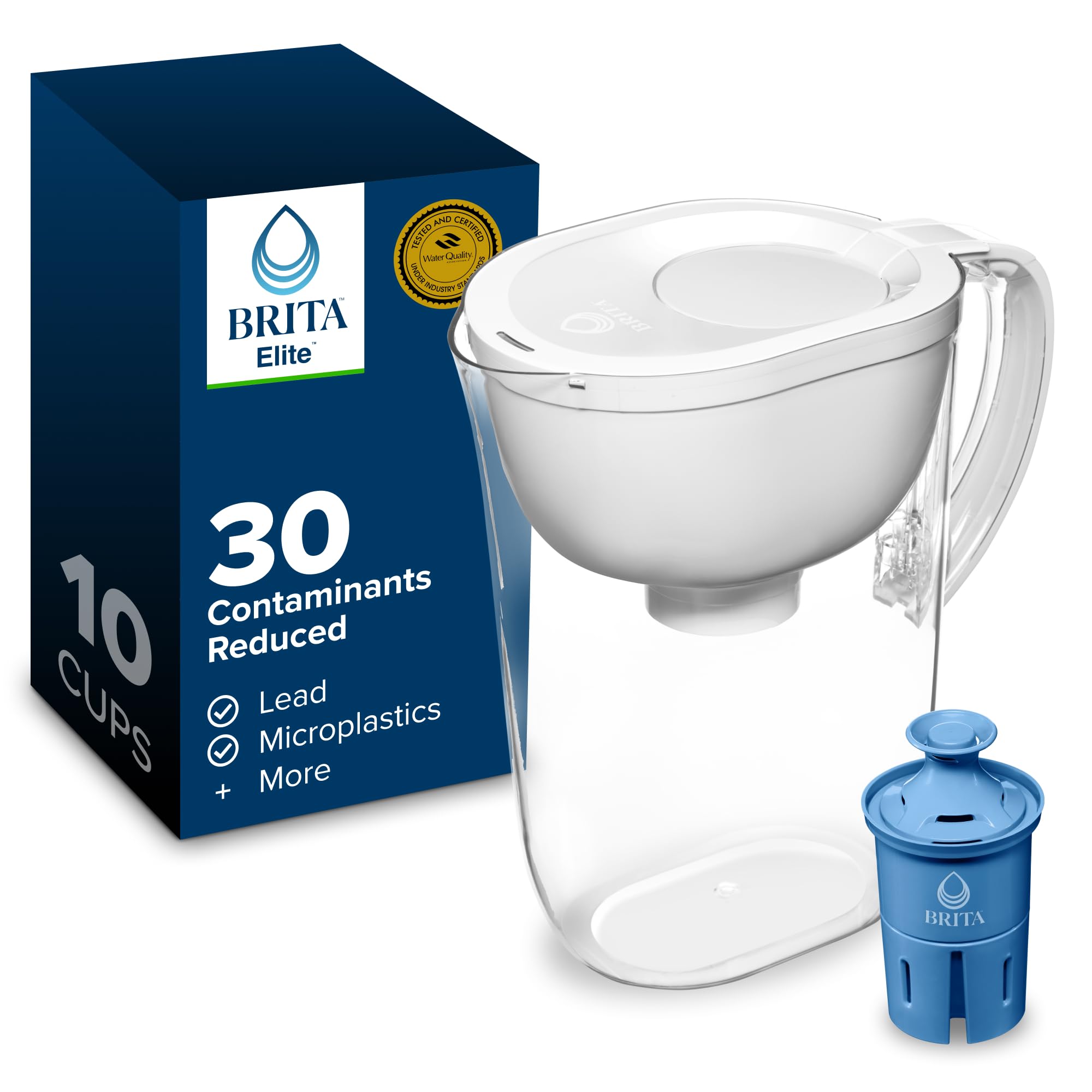
Brita Elite 10‑Cup

Brita Elite 10‑Cup

4.3
  • Capacity: 10 cups
  • Ease of Use: Easy‑fill lid, electronic indicator
  • Replacement Filter Cost: Elite filters, moderate cost
  • Build Quality & Leak Resistance: Plastic pour pitcher
Check Price

Pros

  • Clean, crisp taste backed by certified reduction of lead, microplastics, and 30+ contaminants.
  • Six-month filter life cuts down on replacement frequency.
  • Easy-fill lid and quick filter swaps make daily use straightforward.

Cons

  • Electronic filter indicator may become stuck on or off, requiring manual tracking.
  • Plastic housing can develop cracks near the bottom, leading to leaks.

Unlike Brita’s compact fridge-friendly pitchers, the Elite 10-Cup centers on certified contaminant reduction. Its Elite filter is WQA-certified to reduce 99% of lead, microplastics, and over 30 other contaminants, lasting six months. The 10-cup capacity targets households that prioritize thorough filtration over a space-saving footprint.

This pitcher suits health-conscious buyers who can overlook the potential for housing cracks and an unreliable filter indicator. The plastic body may develop leaks near the base over time, and the electronic indicator can stick, necessitating a manual tracking habit. It’s not the choice for a leak-proof, set-and-forget everyday pitcher.

💡 Tip: Since the filter indicator can be unreliable, mark the installation date on a sticker or set a six-month calendar reminder.

Bottom Line: For contaminant removal that goes beyond taste to include lead and microplastics, the Brita Elite delivers; just plan for the possibility that the housing or indicator won’t outlast the filter inside.
#5

Purest Taste (Zero TDS)

ZeroWater 10‑Cup Pitcher

ZeroWater 10‑Cup Pitcher

4.3
  • Capacity: 10 cups
  • Ease of Use: Pour pitcher, built‑in TDS meter
  • Replacement Filter Cost: Premium‑priced filters
  • Build Quality & Leak Resistance: Plastic, pour spout
Check Price

Pros

  • Built-in TDS meter gives real-time proof zero dissolved solids remain.
  • Reduces lead, chromium, and PFOA/PFOS with IAPMO-certified performance.

Cons

  • Upfront cost sits 2–4× above typical 10-cup pitchers, positioning it as a premium purchase.
  • Filter replacements are expensive and flow can slow noticeably, raising long-term costs and wait times.

The ZeroWater 10-Cup Pitcher uses 5-stage ion exchange to deliver water at 000 TDS, with a built-in meter that removes any guesswork. Unlike the larger ZeroWater dispenser, it keeps the classic pitcher shape — no extra counter space needed.

That absolute purity suits households with high dissolved solids or anyone who wants distilled-quality water without a distiller. Just know that the upfront cost is steep, filter replacements are pricey, and filtration runs slower than standard pitchers — especially in hard-water regions. If you dislike the flat taste of demineralized water or just need better-tasting tap on a budget, this isn't your pitcher.

💡 Tip: If your tap water has high TDS, expect to replace filters more often — budget for that expense upfront.

Bottom Line: This is the pitcher to buy when zero dissolved solids is the goal and you're willing to pay for lab-grade results in a compact shape. For everyone else, the top pick delivers great taste at a fraction of the price.
#6

Budget 10‑Cup Brita Alternative

Amazon Basics 10‑Cup

Amazon Basics 10‑Cup

4.4
  • Capacity: 10 cups
  • Ease of Use: Secure lid, standard pour
  • Replacement Filter Cost: Standard Brita filters, budget‑friendly
  • Build Quality & Leak Resistance: Plastic body, Brita‑filter compatible
Check Price

Pros

  • Budget-friendly price with comparable filtration performance.
  • Delivers fresh, chlorine‑free water using standard Brita filters.
  • Compatible with Brita standard filters for tool‑free installation.

Cons

  • Removing the lid for refilling can require extra force and may lift the inner reservoir.
  • The inner reservoir may develop hairline cracks over months, leading to leaks.

Compared to premium pitchers that demand a higher upfront cost, this unit delivers the same chlorine reduction using the Brita filter ecosystem at a budget-friendly price. Water tastes fresh right out of the tap, and filter installation is straightforward. Households stocked with Brita filters will see immediate savings, and the trade‑offs are manageable for occasional refills.

💡 Tip: Press down on the pitcher base while gripping the lid with your other hand to avoid yanking out the reservoir during refills.

Bottom Line: For Brita users who want a second pitcher at a lower price, this is a rational cost‑cutting move — just expect a finicky lid and plan for eventual replacement.
#7

Tiny fridge space

Brita Slim 5‑Cup

Brita Slim 5‑Cup

4.6
  • Capacity: 5 cups
  • Ease of Use: Flip‑top lid, ultra‑slim
  • Replacement Filter Cost: Standard Brita filters
  • Build Quality & Leak Resistance: Plastic pour pitcher
Check Price

Pros

  • Fits into mini‑fridge doors and narrow shelves where standard pitchers won't go.
  • Makes tap water taste noticeably better by reducing chlorine and odor.

Cons

  • Plastic housing can crack if dropped or handled roughly.

Built for mini‑fridge doors, the Brita Slim 5‑Cup takes up almost no room and still filters out chlorine taste. Two glasses at a time is the limit — frequent refills are unavoidable. The plastic body can crack from a fall, and the per‑cup cost is steep. It only makes sense if no other pitcher fits.

Bottom Line: Worth a purchase only when dimensions dictate the decision; otherwise, larger pitchers offer better value and durability.
#8

Compact small space

PUR 7‑Cup Pitcher

PUR 7‑Cup Pitcher

4.6
  • Capacity: 7 cups
  • Ease of Use: LockFit cap, dishwasher safe
  • Replacement Filter Cost: Affordable PUR filters
  • Build Quality & Leak Resistance: Plastic, pour pitcher
Check Price

Pros

  • Removes chlorine and off-flavors for crisp, clean taste.
  • Slim design tucks into cramped fridge shelves with ease.

Cons

  • The pour spout cover can snap off with regular handling.

The PUR 7-Cup Pitcher gives clean-tasting water and a small footprint ideal for tight fridge shelves. The pour spout cover can snap off with regular use, a fragility that holds it back from a higher spot. At a similar price, another 7-cup option offers longer filter life and a sturdier lid, so this PUR model works best for light use or those already in the PUR filter ecosystem.

Bottom Line: Best suited for existing PUR filter users who need a secondary pitcher for light use; otherwise, a sturdier small-capacity alternative offers longer filter life.
#9

High‑volume pure water

ZeroWater 23‑Cup Disp.

ZeroWater 23‑Cup Disp.

4.3
  • Capacity: 23 cups
  • Ease of Use: Ready‑pour dispenser with TDS meter
  • Replacement Filter Cost: High cost, frequent changes
  • Build Quality & Leak Resistance: Spigot dispenser, plastic
Check Price

Pros

  • Near-zero TDS water with noticeably pure taste
  • Included TDS meter provides real-time filter-change guidance

Cons

  • Filter life can be shorter in high-TDS tap water, raising replacement cost

The ZeroWater 23-cup dispenser strips dissolved solids to negligible levels, and the included TDS meter lets you know when the filter is spent. Ongoing filter replacement can add up, so value-minded families may prefer the Waterdrop 35-Cup for large capacity, and purists who want zero-TDS water may be better served by the smaller ZeroWater pitcher.

Bottom Line: If zero-TDS water in a family-sized dispenser is your goal and your water isn't exceptionally hard, this dispenser delivers clean, measurable purity—just budget for routine filter swaps.

How to Choose

Capacity: Finding the Right Size for Your Household

A 30‑cup dispenser slashes refills but adds a spigot—a potential leak point that many owners eventually deal with. Standard 10‑cup pitchers are simpler and far less prone to dripping, even if you refill them more often. For a fridge door, a slim 5‑cup fits where nothing else will; for a family that drinks water fast, a 23‑cup dispenser avoids constant trips to the sink.

The trade‑off: large capacity dispensers often require more careful handling and can’t be left to sit for days without checking the spigot. Choose the largest size your lifestyle actually demands—not the biggest number on the box.

Filter Lifespan & Certifications: Beyond the Marketing Claims

NSF certifications matter, but not all are equal. NSF 42 covers chlorine taste and odor; NSF 53 is required for lead reduction, and NSF 401 tackles emerging compounds like microplastics. A 200‑gallon filter may sound impressive, but in hard‑water areas dissolved minerals can clog the carbon pores in half the time. Look for pitchers that state exact certifications for the contaminants you care about, and pair them with a calendar or phone reminder—built‑in electronic indicators are often unreliable.

Ease of Use: Lids, Spigots, and Daily Refills

The best lids eliminate the morning fight: a hands‑free auto‑fill flap lets you set the pitcher under the faucet without removing anything. Spigot dispensers make pouring easy without lifting the whole tank, but their seals can wear out and drip over time. A standard pour pitcher avoids that mechanism entirely, at the cost of heavier handling. Inspect the spigot seal every few weeks if you go the dispenser route, and choose a lid design that locks securely if you plan to carry the pitcher to the table.

Build Quality & Leak Resistance: The Six‑Month Test

Plastic pitchers can develop stress cracks at the base or along the handle after repeated temperature changes or a few tumbles. A simple pour pitcher with no spigot is mechanically simpler and less likely to leak onto your shelf. The biggest risk is a spigot that drips constantly—this is the number‑one complaint across large dispensers. If a leak‑free fridge is non‑negotiable, stick with a spigot‑free design.

Replacement Filter Cost: The Real Long‑Term Price

Filter costs can eclipse the pitcher’s purchase price quickly. A $15 pitcher with $12 filters every two months costs more over two years than a $30 pitcher with $8 filters that last six months. Factor in filter compatibility: some pitchers lock you into proprietary cartridges while others accept widely available standards like Brita. Whole‑house water hardness matters too—ZeroWater’s ion‑exchange filters can exhaust in half the time if your tap water has high TDS, doubling the annual bill.

Frequently Asked Questions